
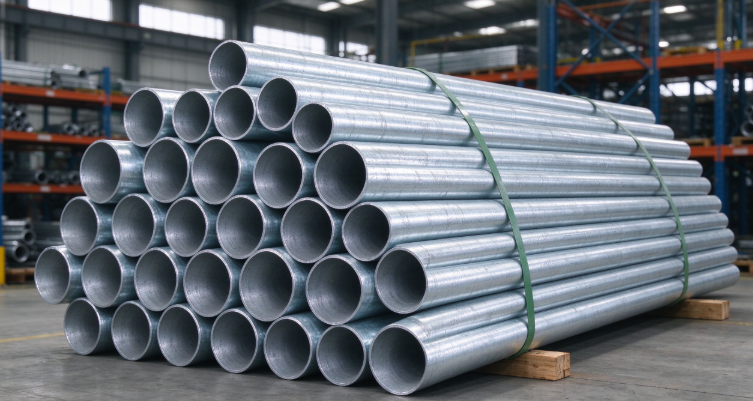
Most bad steel-pipe orders do not start with a dramatic failure. They start with a short RFQ.
“Need 200 tons galvanized seamless pipe. Best price.”
That is enough for a trader to send a number. It is not enough for a manufacturer to know exactly what to make, test or galvanize. By the time the missing details surface — grade, schedule, coating route, end finish, test certificate, marking — the buyer is already comparing prices that were never based on the same product.
I would rather spend ten minutes tightening the specification than spend ten days arguing about what “standard galvanized” was supposed to mean.
Table of Contents
· Start with the base pipe, not the zinc
· Use the standard correctly
· Do not mix batch galvanizing rules with automatic pipe galvanizing
· Specify coating inspection, not just coating language
· Steel chemistry can change the galvanized finish
· Why salt-spray hours can mislead buyers
· Build traceability into the order
· A real long-service galvanized piping case
· RFQ checklist and FAQ
Start With the Base Pipe, Not the Zinc
Galvanizing cannot rescue the wrong pipe. If the base tube does not meet the mechanical, dimensional or testing requirements of the project, a bright zinc surface only makes the wrong material look more finished.
For galvanized seamless steel pipe, define the base pipe first:
· Manufacturing type: seamless
· Product standard
· Grade
· Outside diameter or NPS
· Wall thickness or schedule
· Length
· End preparation
· Required testing and certification
Only then should the zinc-coating requirement be added.
ASTM A53/A53M-24 is often relevant because it covers Type S seamless pipe in Grades A and B and permits hot-dipped zinc-coated supply. The current ASTM page lists NPS 1/8 to NPS 26 in scope. It also makes a point buyers sometimes overlook: nominal wall thickness is a designation, while actual wall thickness can vary within the standard’s requirements. That is why an RFQ should not rely on a vague “heavy wall” description.
Do not confuse a material name with a service approval
A53 pipe may be used in mechanical and pressure applications and ordinary steam, water, gas and air lines within the standard’s scope, but a real project can still have a governing piping code, owner specification, regulatory requirement or media-compatibility rule on top of it.
The words “ASTM A53 galvanized seamless pipe” are a product description. They are not a universal permission slip for every pressure, temperature or chemical service.
The Galvanizing Route Is Part of the Specification
This is one of the most common places where technically weak quotations slip through.
There are several ways zinc can be applied to steel. “Galvanized” by itself is not precise enough for serious procurement. If you require hot-dip galvanizing, write hot-dip galvanizing. If the pipe will be zinc-coated on an automatic production line, make sure the coating requirement is compatible with that route.
Why am I making a fuss about this? Because even familiar standards have boundaries.
ISO 1461:2022 is an international standard for hot-dip galvanized coatings on fabricated iron and steel articles. However, its published scope specifically excludes tube and pipe that are hot-dip galvanized in automatic plants. That does not make ISO 1461 a bad standard; it means you have to use it where it actually applies.
In practical buying terms, “ISO 1461 galvanized seamless pipe” should trigger a follow-up question: How is the pipe galvanized, and which product/coating requirement governs that production route?
That one question can prevent a lot of paperwork theatre.
What Good Surface Preparation Looks Like
In our general batch-galvanizing work for fabricated steel, the process begins long before the zinc kettle. The steel is degreased, pickled to remove rust and scale, rinsed, treated with flux and dried. Only a properly prepared surface can react consistently with molten zinc.
Our process handbook uses a practical zinc-bath range of about 450–470°C for fabricated steel, with immersion time adjusted to section thickness and the workpiece. Those figures are useful process knowledge, but they are not a universal acceptance criterion for automatically galvanized pipe. The buyer should inspect the finished product against the applicable pipe and coating specification, not try to run the galvanizer from the purchase order.
What the process does tell you is where defects often begin. Poor cleaning can produce uncoated areas. Trapped contamination can affect appearance and adhesion. Poor drainage or handling can leave heavy runs and rough areas. If a supplier cannot explain its cleaning, fluxing, dipping and inspection sequence, I would not take its coating claims at face value.
Specify Inspection, Not Just “Good Zinc Coating”
A measurable requirement beats an adjective every time.
The American Galvanizers Association identifies magnetic thickness gauges as a straightforward nondestructive method for measuring zinc coating thickness on hot-dip galvanized steel. Visual inspection is also important because it can reveal bare spots, coating damage, roughness, drainage problems and other surface conditions.
Our steel-processing quality routine follows the same sequence we use for cutting, forming and corrosion protection: incoming material verification, first-piece inspection after a setup change, in-process patrol checks, final inspection and retained quality records. For galvanized seamless pipe, I would adapt that routine around the pipe product rather than force a generic plate-inspection form onto it.
RFQ / Inspection Item | What to State | Why It Matters | Evidence to Request |
Base pipe | Standard, Type S, grade, size, wall / schedule | Defines the actual pipe before coating | Mill test certificate |
Pipe tests | Hydrostatic / NDE / mechanical tests as required by the standard or PO | Confirms pipe-body compliance | Test report or MTC entries |
Zinc process | Hot-dip galvanizing and production route | Avoids confusion with other zinc coatings | Process declaration / supplier specification |
Coating acceptance | Applicable coating requirement and measurement method | Turns “good coating” into a verifiable requirement | Thickness readings and visual inspection record |
End finish | Plain, beveled, threaded, grooved, coupled | End processing can affect zinc coverage | Final dimensional / visual inspection |
Traceability | Heat / lot and galvanizing-batch linkage | Keeps paperwork tied to the physical bundle | Marking, bundle tag, lot record |
Packing | Dry packing, end protection, export bundle requirements | Reduces transport damage and trapped moisture issues | Packing photos / packing list |
Steel Chemistry Can Change the Galvanized Finish
Buyers often expect every bundle to come out of the zinc bath with the same silver appearance. Steel does not always cooperate.
The American Galvanizers Association notes that silicon and phosphorus content in the steel can strongly influence the thickness and appearance of a hot-dip galvanized coating. Certain chemistry combinations can produce thicker, more brittle coatings. Carbon, sulfur and manganese can have smaller effects as well.
This matters when you are ordering a special seamless grade or mixing mills in one project. If appearance is important, tell the supplier before production. If coating performance is the priority, do not reject sound material just because two heats weather to slightly different shades.
A competent galvanizer should review the base-steel chemistry when the coating response looks unusual. A competent buyer should keep the heat numbers traceable so that review is possible.
The Salt-Spray Trap
Our general corrosion-protection manual includes salt-spray testing among coating-quality tools, and salt-spray tests do have their place in controlled comparisons. What I would not do is use a single salt-spray-hour claim as a direct forecast of hot-dip galvanized service life.
The reason is the zinc patina. The AGA explains that the protective patina develops through natural exposure involving wet and dry cycles. Constant-wet salt-spray conditions do not reproduce that mechanism well, so salt-spray results are not considered a reliable predictor of real-world HDG longevity.
This is a good example of why a purchasing document has to be more intelligent than a product brochure. “500-hour salt spray” sounds precise. Without the test standard, specimen condition, pass/fail definition and relevance to the actual coating system, it may tell you less than you think.
Life-Cycle Cost: Use It, but Do Not Invent It
Corrosion protection is an economic decision as much as a technical one. AMPP states that the annual global cost of corrosion exceeds USD 2.5 trillion and that proven corrosion-control practices could save up to 35% of those costs. That does not mean your galvanized pipe will save 35%. It means corrosion management is large enough to deserve a proper life-cycle calculation.
For a pipe package, I would compare:
Total installed cost = base pipe + coating + fabrication + inspection + freight + installation
Then add the expected cost of access, touch-up, recoating, shutdown and replacement over the project’s intended service period. If maintenance access is easy and the environment is mild, galvanizing may not win. If the system is exposed, difficult to repaint and expected to stay in service for years, the economics can change quickly.
The point is to calculate it. Do not borrow a “50-year life” line from somebody else’s website and paste it into your project.
Real-World Case: Valmont Irrigation Machines
An American Galvanizers Association case on Valmont irrigation equipment is a good lesson in why piping owners sometimes move from paint to hot-dip galvanizing.
According to the project record, Valmont turned to hot-dip galvanized steel in 1968 after farmers wanted longer-lasting protection for corroding irrigation pipes. Over the following decades, galvanizing expanded to more components. The case reports that more than 175,000 hot-dip galvanized irrigation systems were sold globally over a forty-year period.
The association also documented an inspection of a Valley center-pivot unit sold in April 1977. After 33 years, the piping, supporting structure and legs were reported to be in excellent condition, with the zinc patina intact and no evidence of corrosion on the galvanized steel.
Again, the source does not identify the irrigation pipe as seamless, so I would not use the case to advertise seamless manufacturing. Its value is different: it is a long-service field example of zinc-coated steel piping exposed to water and weather, which is exactly the kind of evidence worth considering when you are deciding whether corrosion protection should be built into a pipe purchase.
What a Serious Supplier Should Be Able to Show You
You do not need a 70-page supplier audit for every inquiry. You do need enough evidence to know the quoted product exists outside the spreadsheet.
Before the order
Ask for a representative mill test certificate, a sample marking format, the galvanizing process description and a sample coating inspection record. Confirm whether the offered dimensions are regular production or a special rolling / piercing size.
During production
For significant projects, agree on hold points for raw-material identity, first-piece coating acceptance and any witnessed tests. The exact level depends on project risk and order value; there is no virtue in inspecting everything simply because you can.
Before shipment
Match bundle tags to certificates. Review coating appearance, end condition and dimensional checks. Confirm that post-galvanizing cutting or threading has been dealt with as agreed. Make sure documents use the same heat and lot references as the physical material.
This last step sounds painfully basic. It is also where avoidable claims are found.
FAQ
Is hot-dip galvanized seamless pipe the same as pre-galvanized pipe?
No. They describe different coating routes. If your project requires hot-dip galvanizing after the pipe is made, say so explicitly and confirm how the inside and outside surfaces are treated and inspected.
Can I specify coating thickness only in micrometers and ignore the coating standard?
You can write a number, but that does not define the full acceptance system. A proper coating requirement also addresses sampling, measurement method, appearance and any repair or rejection criteria. Use the applicable product or coating standard for the actual galvanizing route.
Why can two galvanized pipes look different even when both pass inspection?
Base-steel chemistry, surface condition and galvanizing behavior can influence coating thickness and appearance. Silicon and phosphorus are particularly influential. Appearance alone is not a reliable substitute for thickness, adhesion and specification compliance.
What documents should come with a B2B galvanized seamless pipe shipment?
At a minimum, the documentation package should match the purchase order: mill test certificate, required test results, coating inspection evidence where specified, packing list and traceable bundle identification. Project-specific third-party inspection or certificates should be listed in the PO before production, not requested after the cargo is ready.
Put the Specification Before the Price
A good galvanized seamless steel pipe order is not complicated. It is complete.
Define the base pipe. Name the governing standard. State the zinc process. Make the coating measurable. Keep heat and lot traceability intact. Then compare prices.
If you are sourcing for an industrial or infrastructure project, send the service environment and technical requirement with the RFQ rather than a one-line product name. A supplier that understands both the pipe and the coating should be able to come back with a technically matched option, the relevant inspection documents and a clear explanation of any limitation before production starts.