
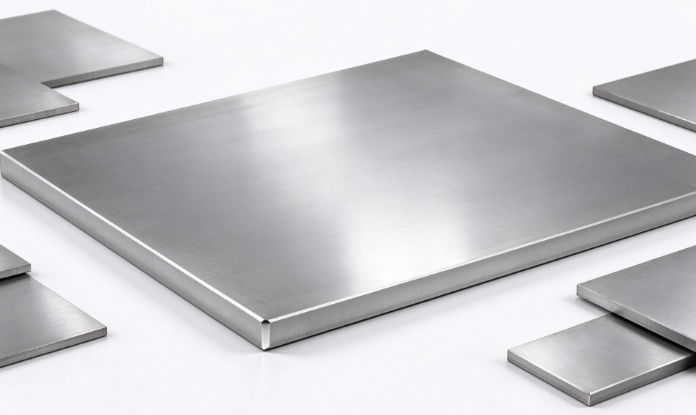
Picking an industrial steel plate supplier usually goes one of two ways. Either you already know your steel — grade, standard, thickness tolerance, the works — and you're really just vetting who can deliver it reliably. Or you're buying plate for a project that's bigger than your in-house metallurgy knowledge, and the supplier's catalog is the first time you've seen half these grade names. Neither situation is unusual, and honestly, most sourcing mistakes happen in that second scenario — not because buyers are careless, but because plate specification sits at the intersection of a dozen overlapping standards systems that don't always translate cleanly into each other.
This guide walks through what actually separates plate categories, how the major standards bodies classify them, what a supplier's paperwork should look like when it's real, and the questions worth asking before you commit to a shipment you can't inspect until it's already on a boat.
What's in This Guide
– What "industrial steel plate" actually covers
– Reading plate grades and standards without getting lost
– What a legitimate supplier's paperwork should look like
– Matching plate type to application
– The sourcing questions that separate a real supplier from a trading desk
– A case study in specification-led sourcing
– FAQ
What "Industrial Steel Plate" Actually Covers
"Steel plate" is really an umbrella term for a handful of quite different products that happen to share a flat, rolled form factor. On one end you've got hot-rolled plate cut to length for general fabrication — brackets, machine bases, frames. On the other end you've got shipbuilding hull plate certified by a classification society, or wear-resistant plate hardened specifically to survive years of abrasive contact in a mining chute. A broad-line supplier's catalog usually spans medium and heavy hot-rolled plate, checkered anti-slip plate, wear-resistant plate, hot-dip galvanized and galvanized checkered plate, cold-rolled plate, pickled plate, galvalume plate, and dedicated shipbuilding-grade plate — each with its own grade range and its own governing standard.
The practical implication for a buyer: don't treat "steel plate" as one line item on a quote request. The moment you specify application — pressure vessel, ship hull, floor decking, structural frame — you've already narrowed the field to a specific family of grades, and that's the conversation worth having with a supplier before thickness and tonnage even come up.
Reading Plate Grades and Standards Without Getting Lost
Four standards systems cover most of the plate moving through international trade, and they don't map onto each other one-for-one, which is exactly where confusion creeps in on cross-border orders.
ASTM International's specifications are the most widely referenced in North America. ASTM A36 is the general-purpose structural workhorse — a constant 36 ksi (roughly 250 MPa) minimum yield point across all thicknesses, which is why it shows up in everything from building frames to bridge components. ASTM A516, by contrast, is a pressure-vessel specification, built around notch toughness for welded vessels running at moderate or lower temperatures, and it comes in four tensile grades — 55, 60, 65 and 70 ksi (380 to 620 MPa) — so "A516" alone isn't a complete spec; the grade number matters as much as the standard name.
Europe works from EN 10025, which grades structural steel by yield strength directly in the designation — S235, S275, S355 — making the number itself a shortcut to the property. Japan's JIS G3101 and G3106 series cover general structural (SS400) and welded-structure (SM490) grades with their own toughness and weldability classifications. And for anything going into a ship hull, the standard isn't a national body at all — it's whichever classification society governs the vessel's registry: CCS, ABS, Lloyd's Register, Bureau Veritas, DNV or the Russian Maritime Register, each running Charpy impact testing at a survey temperature appropriate to the grade.
None of these systems are wrong, they're just different lenses on similar underlying metallurgy. A supplier that can speak fluently across ASTM, EN, JIS and classification-society terminology in the same conversation is usually one that's actually handled multi-market export orders, not just domestic sales translated into English.
Standard | Governing Body | Typical Grades | Core Property Spec | Common Use |
ASTM A36 | ASTM International (USA) | A36 | Min. 36 ksi (250 MPa) yield, all thicknesses | General structural fabrication, buildings, bridges |
ASTM A516 | ASTM International (USA) | Gr. 55 / 60 / 65 / 70 | 55–90 ksi (380–620 MPa) tensile, notch toughness | Pressure vessels, moderate/low-temp service |
EN 10025 | CEN (Europe) | S235 / S275 / S355 | Yield strength keyed to grade number (MPa) | European structural steelwork, CE-marked projects |
JIS G3101 / G3106 | JISC (Japan) | SS400 / SM490 | Yield & tensile per grade, weldability class | Japanese-spec structures, machinery, welded assemblies |
Classification Society Rules | CCS / ABS / LR / BV / DNV / RS | Grade A–E (mild), AH–EH (higher strength) | Charpy impact toughness at survey temperature | Shipbuilding, hull plate, offshore structures |
What a Legitimate Supplier's Paperwork Should Look Like
Certification is where a lot of plate sourcing quietly goes wrong, mostly because a PDF with a logo on it is easy to produce and harder to verify from a distance. A few things worth knowing:
• Mill Test Certificate (MTC), sometimes called a 3.1 certificate, is issued heat-by-heat and should show actual chemical composition and mechanical test results for the specific batch you're buying — not a generic spec-sheet reprint. If a supplier can't produce a heat-specific MTC, ask why.
• ISO 9001:2015 certifies the quality management system, not the steel itself — it tells you the supplier has documented, repeatable processes, which matters for consistency across large or repeat orders.
• Third-party inspection — SGS, Bureau Veritas (BV) or TÜV are the names that show up most often in export steel trade, and a supplier willing to accommodate pre-shipment inspection by one of these is signaling confidence in what's actually in the warehouse.
• Destination-specific certification — CE documentation for EU-bound construction steel, API for oil & gas tubular goods, JIS certification for Japan-spec orders — should be confirmed before the order is placed, not requested after the container has sailed.
A reasonable rule: any supplier quoting plate for a structural, pressure-vessel or classification-society application should be able to tell you, unprompted, which of these documents come standard with the order and which require advance notice.
Matching Plate Type to Application
Here's a working reference for how plate category, typical governing standard and real-world use tend to line up — useful as a starting checklist before you narrow down to a specific grade and mill.
Plate Category | Typical Thickness Focus | Where It's Actually Used | What to Verify Before Ordering |
Hot-Rolled Plate | General purpose, cut-to-length | Machinery bases, brackets, general fabrication | Flatness, mill certificate, grade consistency across the coil |
Medium & Heavy Plate | 4mm and up | Bridges, heavy structures, pressure equipment | Ultrasonic testing (UT) availability, through-thickness properties |
Shipbuilding Plate | Class-society governed | Hull plating, deck structures, offshore platforms | Class society approval (CCS/ABS/LR/BV/DNV/RS), impact test data |
Wear-Resistant Plate | High-hardness, HB320–550 range | Mining chutes, crusher liners, port/construction machinery | Hardness test report, whether hardness is through-thickness or surface only |
Hot-Dip Galvanized Plate | Zinc-coated | Construction, appliances, outdoor and coastal structures | Coating weight (g/m²), zero-spangle vs standard spangle finish |
Checkered / Anti-Slip Plate | Patterned surface | Factory floors, stair treads, platforms, decking | Pattern height and consistency, base steel grade underneath |
Wear-resistant plate deserves a specific callout because the hardness figure alone doesn't tell the whole story. A Brinell hardness in the 320–550 HB range delivers meaningfully longer service life in abrasive environments — mining chutes, crusher liners, port handling equipment — but hardness that's only achieved at the surface through a thin hardened layer behaves very differently under sustained abrasive wear than hardness that holds through the plate's thickness. That's a fair question to put directly to a supplier, not something to assume from a spec sheet.
The Sourcing Questions That Separate a Real Supplier from a Trading Desk
Anyone can list forty-eight product categories on a website. What's harder to fake is the operational backbone behind actually delivering on them. A few questions worth asking directly:
• How much of what's quoted is physically in stock versus mill-order lead time? A supplier working from genuine warehouse inventory can typically confirm dispatch in days; one working purely on mill allocation is quoting weeks, whether they say so upfront or not.
• Which Incoterms are actually supported end-to-end — EXW, FOB, CFR, CIF, DDP — and does that change based on destination country or order size?
• Can they trace a specific coil or plate lot back to its originating mill heat number if a quality question comes up after delivery?
• Do they work with a defined network of partner mills, or does sourcing change order to order? A stable mill relationship usually means more consistent grade compliance across repeat orders.
None of these questions are hostile — a supplier confident in their own supply chain answers them without hesitation, because the answers are the actual selling point.
A Case Study in Specification-Led Sourcing
It's worth looking at what "getting the spec right" actually means at the scale of a mega-infrastructure project. The Hong Kong–Zhuhai–Macao Bridge — a 55-kilometer sea-crossing structure linking the Pearl River Delta region, and the longest of its kind in the world — was engineered to a 120-year design service life in a semi-tropical marine environment with high temperature, high humidity and high salinity. That's an extraordinarily demanding corrosion environment for steel structure components, and durability research published on the project documented specific anti-corrosion measures for the steel box girder, bridge deck, cable-stayed elements and steel anchor boxes, precisely because a 120-year maintenance-free target leaves almost no room for a plate batch that doesn't meet its stated mechanical or chemical properties.
The lesson scales down to ordinary structural and pressure-vessel plate orders too: the gap between "steel that looks right" and "steel that's certified and traceable to the standard your engineer actually specified" is exactly the gap that shows up ten or twenty years into a structure's service life, long after the invoice is closed. Projects operating at that level of scrutiny don't treat mill certificates as paperwork — they treat them as the actual product.
FAQ
What's the real difference between ASTM A36 and A516 plate?
A36 is a general structural specification — a flat 36 ksi minimum yield across all thicknesses, used for buildings, frames and general fabrication. A516 is a pressure-vessel specification built around notch toughness for welded vessels, sold in four distinct tensile grades (55–70 ksi). They're not interchangeable — using A36 where a pressure-vessel spec calls for A516 is a code-compliance problem, not a cost-saving shortcut.
Do I need classification-society certification for every steel plate order?
No — that requirement is specific to marine and offshore applications where the finished structure needs to be surveyed and registered under a classification society (CCS, ABS, LR, BV, DNV, RS). Structural, pressure-vessel and general fabrication plate follow their own relevant standards instead.
How can I verify a Mill Test Certificate is genuine before the shipment arrives?
Ask for the certificate to reference a specific heat number tied to your order, and consider requesting third-party pre-shipment inspection through an independent body like SGS or Bureau Veritas, which can verify the physical material against the paperwork before it leaves port.
Is hot-dip galvanized plate always the right corrosion-resistance choice?
It's a strong default for many outdoor and coastal applications, but not universal — zinc-aluminum-magnesium coatings and Galvalume (aluminum-zinc alloy) coatings offer several times the corrosion life of standard galvanizing in certain environments, so it's worth comparing coating type against your specific exposure conditions rather than defaulting to whichever is quoted first.
Bringing It Back to the Order Sheet
Global steel output runs close to 1.9 billion tonnes a year, with a small handful of countries — China alone accounts for roughly half of it — supplying most of the world's traded plate. At that scale, the standards and certification chain aren't bureaucratic overhead; they're the only practical way an engineer in one country can trust a plate rolled in a mill they'll never visit. Specify the standard and grade your application actually needs, ask for heat-specific documentation, and treat a supplier's willingness to answer traceability questions directly as a genuine signal, not a formality.
If you're sizing an order and want a second opinion on which grade and standard actually fit your application, that's worth raising with your supplier before the purchase order goes out — not after the plate is already on the water.