
I've been in steel procurement for nearly two decades, and I still see the same mistake repeated. A buyer gets three quotes, picks the lowest price per ton, and then spends the next six months dealing with cracked edges, out-of-spec yield strength, and delivery dates that keep sliding. The plate itself isn't the problem. The supplier is.
The global hot rolled steel plate market was valued at approximately USD 180.4 billion in 2025 and is projected to reach USD 238.3 billion by 2033, growing at a steady 3.55% CAGR. That's an enormous volume of material moving through supply chains every year. And a significant portion of it moves through suppliers who cannot produce a valid Mill Test Certificate, cannot trace a heat number back to the mill, and cannot tell you what the actual yield strength was on the last batch they shipped.
This guide is about avoiding those suppliers. It's about understanding what a hot rolled steel plate supplier actually needs to provide, and how to evaluate them before you commit to a contract.
Why Hot Rolled Plate Is Different from Other Steel Products
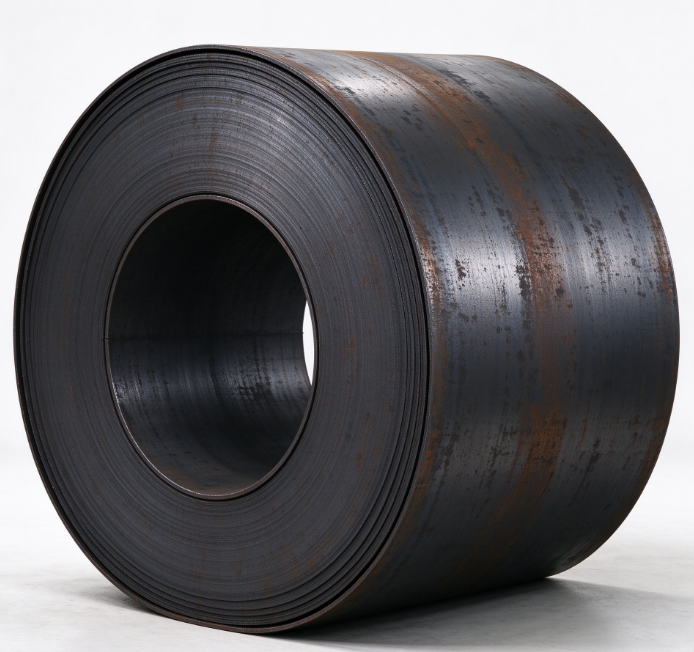
Hot rolling happens above the steel's recrystallization temperature, typically over 900°C. The steel is deformed and shaped while it's soft and malleable. When it cools, it retains a rough, oxide-covered surface known as mill scale, and it develops the mechanical properties that make it suitable for structural and industrial applications.
That process produces a material with specific advantages. Good formability. Weldability. A strength-to-cost ratio that makes it the default choice for construction, shipbuilding, heavy machinery, and infrastructure projects. It's also why hot rolled plate is the most common steel product in the world.
But the same process that makes hot rolled plate useful also makes it variable. The mill scale on the surface can vary in thickness and adhesion. The thickness tolerance can swing depending on the mill and the standard being followed. And the mechanical properties depend on the specific grade and the heat treatment condition.
A supplier who doesn't understand these variables will sell you plate that looks fine on the invoice and fails on the shop floor.
What Actually Matters When Evaluating a Supplier
Price is a data point, not a decision. Here's what I actually check when I'm qualifying a new hot rolled steel plate supplier.
Standards Compliance and Certification
The first question is simple: what standards do you work to? A serious supplier will answer immediately. ASTM A36 is the baseline for general structural applications. ASTM A572 Grade 50 is the standard for higher-strength structural work. EN 10025 S235, S275, and S355 are the European equivalents, and many suppliers work to both ASTM and EN frameworks.
Compliance isn't just about the grade. It's about the dimensional tolerances. ASTM A6/A6M covers the permissible variations for structural plates, including thickness, width, length, and flatness. EN 10029 is the European counterpart. A supplier who can't tell you which tolerance standard they're working to is a supplier who will ship you plates that don't fit.
Mill Test Certificates and Traceability
Every batch of hot rolled plate you receive must come with a Mill Test Certificate that traces back to the exact heat number from the mill. The gold standard is EN 10204 3.1 or 3.2 certification. Type 3.1 means the certificate is issued by the manufacturer's independent inspection representative. Type 3.2 requires a third-party inspection body to validate the results.
I've seen suppliers provide certificates that list "typical properties" instead of actual test results. That's not a Mill Test Certificate. That's a marketing document. If the certificate doesn't have a heat number, a certificate number, and actual measured values for chemical composition, yield strength, tensile strength, and elongation, it's not worth the paper it's printed on.
Production Capacity and Flexibility
A supplier who can only offer standard sizes and grades is fine for simple projects. But if you need custom dimensions, specific edge conditions, or non-standard thicknesses, you need a partner who can actually produce what you need.
The key question is whether the supplier has direct mill relationships or is dependent on a single source. A supplier with multiple mill relationships can flex between sources when one mill has a production issue or a scheduling delay. A supplier dependent on one mill is only as reliable as that mill's worst quarter.
Response Time and On-Time Delivery
These are the operational metrics that separate serious suppliers from order-takers. Industry benchmarks for reliable suppliers include response times under two hours during business hours and on-time delivery rates above 95%. A supplier who takes three days to answer a technical question will take three weeks to resolve a quality issue.
Reorder rate is another telling metric. A supplier with a high reorder rate has customers who come back. That's the simplest signal of consistent quality and service.
A Framework for Comparing Hot Rolled Plate Suppliers
Here's how I evaluate the suppliers I work with. This table distills the key criteria into a practical scoring format.
Evaluation Criteria | What to Look For | Red Flag |
Standards compliance | Clear documentation of ASTM, EN, or JIS adherence | Vague or evasive answers about which standards they follow |
MTC quality | EN 10204 3.1 or 3.2 issued per heat number with actual test results | "Typical values" instead of measured data |
Mill relationships | Multiple mill sources, verifiable supply chain | Single source dependency, no mill visibility |
Production capacity | Flexible sizing, custom cutting, in-house processing | No processing capability, pure trading operation |
Response time | Under 2 hours during business hours | Days of silence after initial inquiry |
On-time delivery | ≥95% documented delivery rate | Frequent excuses, no tracking system |
Reorder rate | Above 40% indicates customer satisfaction | Low reorder rate suggests quality or service issues |
That 95% on-time delivery rate and two-hour response time come directly from industry benchmarks for reliable steel suppliers. They're not arbitrary. They're the minimum acceptable performance levels for a serious procurement partnership.
The Value of Processing Services
One of the most significant shifts in hot rolled steel plate sourcing over the past five years is the growth of value-added processing. Instead of buying raw plates and doing all cutting, drilling, and beveling in-house, more manufacturers are having the supplier deliver plates that are ready for assembly.
The numbers back this up. The cut-to-length service segment of the steel processing market grew at a CAGR of 8.4% from 2020 to 2025, reaching an estimated market size of USD 1.71 billion. Heat treating services grew at 7.3% over the same period. These aren't niche services anymore. They're becoming standard expectations.
When you buy processed plates, you eliminate secondary operations from your production schedule. You reduce material waste because the supplier can nest parts more efficiently than you can on a single cutting table. And you shift the quality control burden to the supplier, who has dedicated equipment and trained operators.
A Real Case Study: When Cheap Plate Costs the Most
A fabrication shop I worked with decided to save 15% on their hot rolled plate costs by switching to a new supplier they found on a B2B platform. The quotes were significantly lower, and the lead times looked competitive.
The first shipment arrived a week late. The plates were correct in grade and thickness, but the edges were rough and out of square. The shop had to spend extra hours grinding and re-cutting before they could even start fabrication. The second shipment arrived with Mill Test Certificates that listed "typical" properties instead of actual test results. When the shop pushed back, the supplier explained that "this is how we always do it."
By the time the project was complete, the shop had lost more money in rework, delays, and administrative hassle than they had saved on the plates. They went back to their original supplier and negotiated a volume discount instead.
The lesson is straightforward. The lowest price per ton is meaningless if you have to pay for it in labor, delays, and quality failures. When you compare quotes, compare the total cost of ownership, not just the invoice.
Navigating Logistics and Lead Times
Hot rolled plate is heavy, and shipping it is expensive. A supplier's proximity to a port or a major logistics hub directly affects your landed cost. Suppliers in regions like Shandong province in China, for example, operate within 50 kilometers of Qingdao Port, one of Asia's busiest cargo hubs. That proximity slashes freight costs and transit delays, giving international buyers a 15–25% cost advantage over sourcing from Europe or Southeast Asia.
Lead times vary significantly by product and supplier. Standard stock sizes can ship within 7 to 10 days. Custom processing adds 3 to 7 days depending on complexity. For heavy plates in structural grades, normal lead times from European mills can run 5 to 8 weeks, with expedited options available at a premium.
The key is to understand your supplier's actual lead time performance, not their quoted lead time. Ask for historical data. A supplier who consistently delivers within their quoted window is worth more than one who quotes shorter but delivers late.
Price Volatility and How to Manage It
Steel prices move. Iron ore, coal, and scrap costs fluctuate, and those fluctuations pass through to plate prices with a lag. As of late 2026, Chinese hot rolled coil export prices were hovering around USD 498 per ton FOB, with medium plates at USD 518–536 per ton FOB. These numbers shift week to week based on demand, trade policy, and raw material costs.
The most effective way to manage price volatility is to structure contracts with price adjustment mechanisms tied to recognized steel indices like Platts or Mysteel. This protects both you and the supplier from sudden market swings. For spot purchases, monitor the index trends and time your orders accordingly. Don't chase the bottom. You'll miss it more often than you'll catch it.
Sustainability and the Circular Economy
Steel is the most recycled material on the planet. Hot rolled plate has an end-of-life recycling rate of 90–95%, and the production process already incorporates significant scrap content. But the industry is moving beyond recycling. Low-carbon production routes using electric arc furnaces powered by renewable energy are producing hot rolled plate with carbon emissions as low as 400 kg CO₂ per ton, roughly one-fifth of conventional blast furnace emissions.
For buyers with sustainability commitments, this matters. Ask your supplier about their production route. A mill using EAF with high scrap content and renewable electricity can provide a significantly lower carbon footprint than a traditional integrated mill. Some suppliers are now offering Environmental Product Declarations that quantify the carbon footprint of specific plate products.
Frequently Asked Questions
How do I verify a Mill Test Certificate is genuine?
Contact the issuing mill directly. The MTC should have a unique heat number and a certificate number that the mill can verify. If the mill can't confirm the certificate, it's not real. Also check that the certificate is issued per EN 10204 3.1 or 3.2 standards, not as a "typical properties" document.
What's the difference between a manufacturer and a stockist?
A manufacturer produces steel plates from raw materials. A stockist buys and resells plates that someone else made. For critical applications, you usually want to deal with a manufacturer or a stockist who has direct, verifiable relationships with specific mills. Pure traders add cost without adding value.
Can I get custom sizes and grades from a reliable supplier?
Yes, but you need to verify their capability upfront. Ask for a sample production run before committing to a large order. A supplier who can't produce a small trial batch to your specifications won't magically get it right on a 500-ton order.
What certifications should a hot rolled steel plate supplier hold?
At minimum, look for ISO 9001 for quality management. For specific applications, you may need additional certifications. For shipbuilding, classification society approvals from ABS, DNV, or Lloyd's Register matter. For European structural projects, EN 1090 for execution of steel structures is often required. For pressure vessels, ASME certification is the baseline.
How do I handle quality issues with a new supplier?
Establish clear acceptance criteria in your purchase order. Require dimensional inspection reports for critical dimensions. And always inspect incoming material before it goes into production. If there's an issue, document it immediately and notify the supplier. A good supplier will resolve it. A bad one will blame you.
The Bottom Line
Sourcing hot rolled steel plate is not about finding the cheapest price per ton. It's about finding a supplier who can deliver certified material, on time, at consistent quality. Check their standards compliance. Verify their Mill Test Certificate process. Assess their production capacity and mill relationships. And always, always run a trial order before committing to a large contract.
The plate itself is a commodity. The supplier is not. Choose accordingly.
If you're evaluating hot rolled steel plate suppliers for an upcoming project and need help cutting through the sales talk, send us your specifications. We'll give you a straight answer on what to look for and what to avoid.