
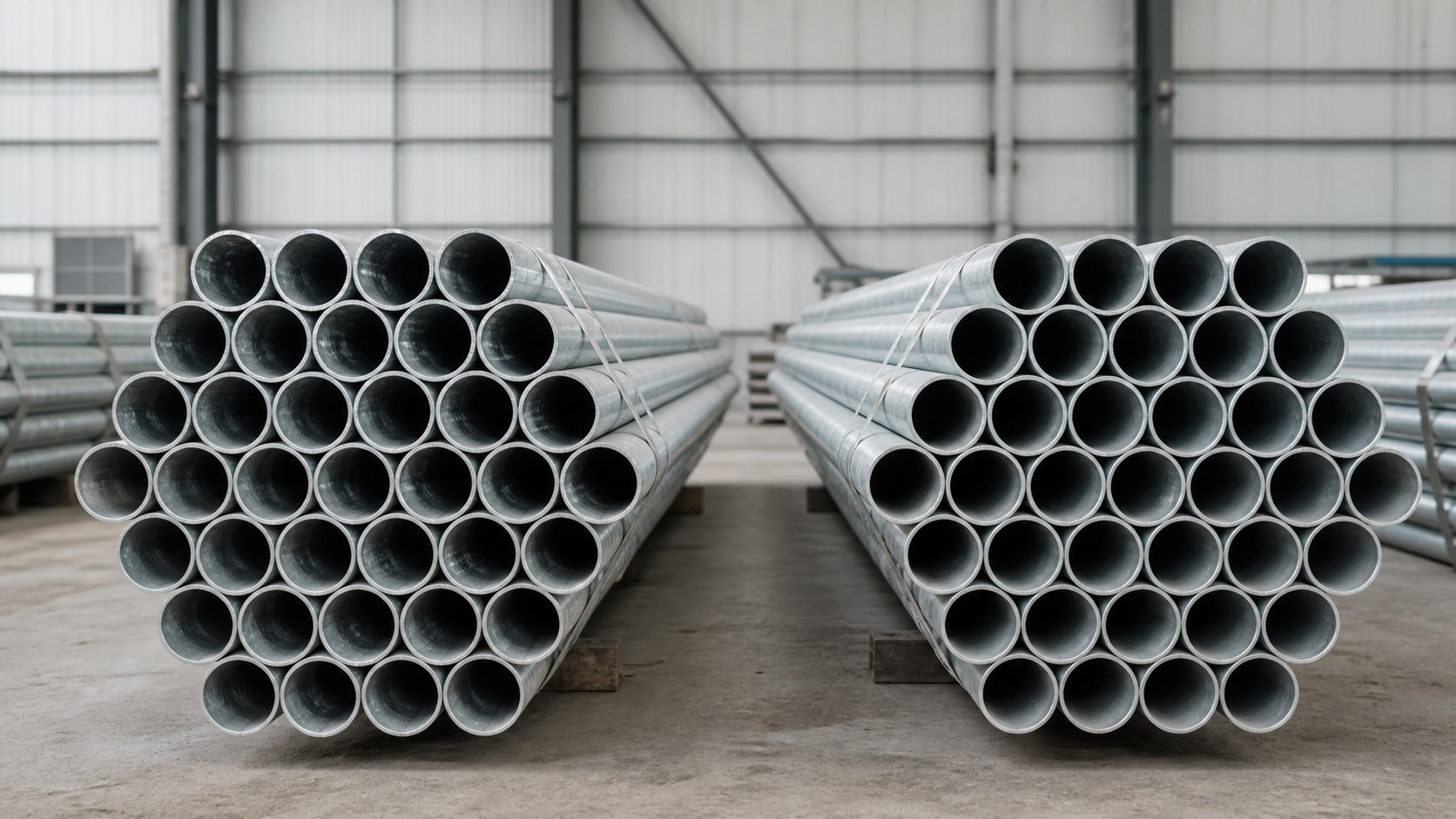
By the Technical Engineering Team at Shanghai Banzhijia Steel Processing. With over 15 years of specialized steel manufacturing and anti-corrosion processing experience, our team delivers production-proven solutions for structural, industrial, and renewable energy projects worldwide.
Key Takeaways
Hot-dip galvanizing (HDG) applies a thick, metallurgically bonded zinc coating after fabrication, delivering 20–50+ years of complete, self-healing protection for outdoor and heavy-duty steel components. Pre-galvanizing coats flat steel coils before fabrication, creating a thinner, smoother finish with exposed raw edges — a cost-effective choice for dry, indoor applications with a 3–8 year service life expectation.
Table of Contents
1. Core Process Differences: Galvanizing Before or After Fabrication?
2. Side-by-Side Performance Comparison
3. Corrosion Resistance: Lab Testing and Real-World Service Life
4. Cost Analysis: Upfront Price vs. Total Lifecycle Expense
5. Key Application Scenarios for Each Galvanizing Process
6. Real-World Case Study: Industrial Warehouse Structural Frame
7. 3-Step Decision Checklist: Which Process Fits Your Project?
8. Frequently Asked Questions About Galvanized Steel
9. Final Selection Guide and Next Steps
1. Core Process Differences: Galvanizing Before or After Fabrication?
The most fundamental distinction between the two processes lies in when the zinc coating is applied relative to steel fabrication — a sequence that defines every other performance and cost difference.
1.1 Hot-Dip Galvanizing (Post-Fabrication Coating)
Hot-dip galvanizing is a batch process applied after steel components are fully cut, formed, and welded. The complete workpiece undergoes a rigorous pre-treatment sequence — degreasing, acid pickling, rinsing, and flux application — before being fully immersed in a bath of molten zinc held at 450–470°C.
During immersion, a metallurgical diffusion reaction occurs between the iron in the steel and the liquid zinc, forming four distinct bonded layers: Gamma, Delta, Zeta, and Eta. The inner alloy layers deliver exceptional hardness and adhesion, while the outer pure zinc (Eta) layer provides primary corrosion resistance. This diffusion bond covers every surface, including internal cavities, edges, and weld seams, with thicker coverage naturally forming at corners and high-wear edges.
On the shop floor, a critical practical consideration for HDG is that any enclosed or hollow sections must be designed with vent and drain holes. Without proper openings, trapped air or boiling zinc can build pressure and cause hazardous blowouts during immersion. The process follows global standards such as ASTM A123-24 in North America and GB/T 13912-2020 in China, with strict requirements for minimum coating thickness and adhesion.
1.2 Pre-Galvanizing (Pre-Fabrication Coating)
Pre-galvanizing, also called in-line galvanizing, applies the zinc coating to flat steel coils or strips before any cutting, forming, or welding takes place. The steel strip runs continuously through a galvanizing line, receiving a thin, uniformly controlled zinc layer. Common commercial grades include G90 (Z275, 275 g/m² zinc coating) and G60 (Z180), with G90 serving as the baseline for most structural pre-galvanized products. The material typically conforms to ASTM A653 or GB/T 2518 standards.
Fabricators then purchase pre-galvanized coils and process them into finished parts through shearing, bending, roll forming, and welding. While thin pre-galvanized sheets (<1.5 mm) benefit from limited sacrificial protection at cut edges, thicker sections, punched holes, and field welds expose raw steel that will corrode rapidly without secondary zinc-rich primer touch-up.
In actual stamping and bending operations, the thin, uniform pre-galvanized coating can develop micro-cracks along tight bend radii. These cracks are rarely visible to the naked eye but can become initiation points for corrosion in outdoor service.
2. Side-by-Side Performance Comparison
The table below summarizes key technical specifications for both processes, based on industry standards and independent testing data.
表格
Performance Metric | Hot-Dip Galvanizing | Pre-Galvanizing (G90/Z275) |
Typical Coating Thickness | 65–120 μm (varies with steel thickness) | 8–30 μm (continuous line controlled) |
Coating Structure | 4-layer metallurgical bond (Gamma/Delta/Zeta/Eta) | Single pure zinc layer, physical adhesion |
Coating Adhesion | Grade 1 (no peeling under bending) | Grade 2 (risk of chipping at sheared edges) |
Cut & Weld Edge Coverage | ✔ Full, uniform coverage on all surfaces | ✘ Bare steel exposed; requires manual touch-up |
Neutral Salt Spray (white rust onset) | ≥500 hours | ≥72 hours |
Expected Outdoor Service Life (temperate C3 environment) | 20–50 years | 3–8 years (intact coating only) |
Primary Applicable Standards | ASTM A123-24, EN ISO 1461, GB/T 13912-2020 | ASTM A653, GB/T 2518 |
Relative Initial Cost (per ton of steel) | 100% (baseline) | 60–75% |
Note: Accelerated neutral salt spray results serve as a relative performance benchmark. For hot-dip galvanized steel, long-term field exposure testing per ISO 9223 and service life classifications under ISO 12944 are the authoritative indicators of real-world durability.
Data sources: American Galvanizers Association, Galvanizers Association of Australia 2024 Technical Guide, GB/T 13912-2020, ASTM A123-24
3. Corrosion Resistance: Lab Testing and Real-World Service Life
Corrosion performance is the primary reason most buyers choose galvanized steel, and this is where the gap between the two processes is most pronounced.
3.1 Dual Protection Mechanism vs. Barrier-Only Protection
Hot-dip galvanizing provides two layers of defense: physical barrier protection and sacrificial cathodic protection. The dense zinc-iron alloy layer blocks moisture and corrosive chemicals from reaching the steel substrate. If the coating is scratched or chipped, the zinc acts as a sacrificial anode, corroding first to protect the exposed steel over a wide area.
Pre-galvanized coatings rely almost entirely on barrier protection. The thin pure zinc layer offers limited sacrificial capacity, and any break in the coating can lead to localized rust that spreads quickly under the film. For components with cut edges or welded joints — nearly all fabricated parts — this weakness is amplified, as bare steel areas have no meaningful galvanic protection at all.
3.2 Service Life by ISO 12944 Corrosivity Class
Independent field exposure data aligned with ISO 12944 atmospheric corrosivity classifications shows clear performance gaps:
· C2 (Rural / Low pollution): HDG service life of 40–70 years; pre-galvanized 10–15 years (indoor equivalent)
· C3 (Urban / Light industrial): HDG service life of 25–40 years; pre-galvanized 3–8 years if used outdoors
· C5 (Coastal / Heavy industrial): HDG service life of 15–25 years; pre-galvanized 1–3 years before significant red rust appears
In practice, pre-galvanized steel is rarely specified for permanent outdoor structural use unless paired with an additional paint or powder coating topcoat system.
4. Cost Analysis: Upfront Price vs. Total Lifecycle Expense
Cost is often the deciding factor for procurement teams, but a narrow focus on initial material price can be misleading over the full asset lifecycle.
4.1 Upfront Material Cost
Pre-galvanized steel coils carry a lower per-ton premium than hot-dip galvanized fabricated parts. On average, pre-galvanized material adds 60–75% of the cost of hot-dip galvanizing when compared on a pure coating basis. This price advantage comes from the high efficiency of continuous coil coating lines, which process thousands of tons per day with minimal labor input.
4.2 Lifecycle Cost Comparison
When evaluated over a 25-year project lifecycle, hot-dip galvanizing consistently delivers lower total cost of ownership. A 2023 study by the UK Galvanizers Association found that for a typical 240-tonne steel-framed industrial building, a three-coat paint system cost 35% more upfront than hot-dip galvanizing and required repainting every 10–15 years. Pre-galvanized steel, while cheaper initially, would require full refurbishment or replacement 2–3 times over the same 25-year window.
For structural components that are difficult to access for maintenance — such as roof trusses, bridge supports, or underground pipe supports — the lifecycle cost gap widens even further, as labor for repair and repainting can exceed the original material cost many times over.
5. Key Application Scenarios for Each Galvanizing Process
Neither process is universally better; each excels in specific use cases where its strengths align with project requirements.
5.1 Where Hot-Dip Galvanizing Is the Clear Choice
Hot-dip galvanizing is the preferred solution for any application where long-term durability and low maintenance are priorities. Common use cases include:
· Outdoor structural steel for factories, warehouses, and stadiums
· Transmission towers, photovoltaic support structures, and wind farm components
· Highway guardrails, sound barriers, and bridge accessories
· Water supply pipelines, sewage treatment equipment, and marine engineering parts
· Agricultural equipment and livestock housing frames exposed to ammonia and moisture
For these components, the full coverage, thick coating, and sacrificial protection of post-fabrication galvanizing deliver reliable performance with minimal ongoing upkeep.
5.2 Where Pre-Galvanizing Delivers Value
Pre-galvanizing is a cost-effective option for indoor, low-corrosion environments with simple part geometries. Typical applications include:
· Electrical enclosure cabinets and cable trays
· Indoor furniture, shelving, and storage racking
· Appliance housings and interior automotive components
· Drywall studs, ceiling grids, and other interior building products
For these parts, the thin, smooth zinc layer provides sufficient rust protection during storage and installation, and the lower material cost aligns with high-volume, price-sensitive production.
6. Real-World Case Study: Industrial Warehouse Structural Frame
In 2008, a logistics company in Jiangsu, China, constructed two identical 12,000 m² warehouse buildings to compare long-term performance of different steel protection systems. Building A used pre-galvanized C-section purlins (G90 grade) with field touch-up paint on cut edges; Building B used fully fabricated structural steel processed via hot-dip galvanizing in accordance with GB/T 13912.
A third-party inspection conducted in 2023, after 15 years of service, revealed the following results:
表格
Performance Metric | Building B (Hot-Dip Galvanized) | Building A (Pre-Galvanized) |
Coating surface condition | ~97% of surfaces intact; minor white rust only at lap joints | 41% of cut/weld edges show visible red rust |
Coating degradation | 19% of purlins with coating blistering | 19% of purlins with under-film blistering |
Structural red rust detected | None | Concentrated at unsealed cut edges and roof laps |
Estimated remaining service life | 25+ years | 3–5 years before required refurbishment |
Estimated 3-year maintenance cost | Minimal inspection only | ~¥1.2 million for full repainting |
Corrosion on Building A was heavily concentrated along the unsealed cut edges of C-purlins and roof lap joints — areas where the original coating was removed during fabrication and field touch-up paint had worn away. This case aligns with broader industry data: while pre-galvanized steel reduces initial construction cost, it creates significantly higher maintenance and replacement expenses over the asset’s lifetime.
7. 3-Step Decision Checklist: Which Process Fits Your Project?
Use this simple framework to narrow down the right galvanizing method for your application:
1. Will the component be used outdoors or in a corrosive environment? If yes, hot-dip galvanizing is the default choice for long service life.
2. Does the part require extensive cutting, welding, or punching after coating? If yes, post-fabrication HDG eliminates exposed raw edges and touch-up labor.
3. Is the part for dry indoor use with high cost sensitivity? If yes, pre-galvanized steel delivers sufficient protection at a lower upfront price.
8. Frequently Asked Questions About Galvanized Steel
Q1: Is pre-galvanized steel the same as electro-galvanized steel?
Not exactly. Pre-galvanizing refers to any coating applied before fabrication, which can include continuous hot-dip galvanized coil (the most common structural type) or electro-galvanized coil. Electro-galvanizing produces an even thinner, more uniform coating (5–25 μm) used primarily for automotive and appliance parts. Most structural pre-galvanized steel is produced via continuous hot-dip lines, not electroplating.
Q2: Can I weld hot-dip galvanized steel?
Yes, hot-dip galvanized steel can be welded using standard methods, but proper ventilation is required to avoid zinc fume fever. After welding, the affected area should be cleaned and touched up with zinc-rich paint to restore corrosion protection. For critical components, many fabricators prefer post-fabrication galvanizing — welding first, then dipping — to eliminate this issue entirely.
Q3: Which process is better for coastal or high-salt environments?
Hot-dip galvanizing is strongly recommended for coastal and industrial environments classified as C4 or C5 under ISO 12944. Its thick coating and sacrificial protection can withstand 20–30 years of exposure to salt spray and industrial pollutants. Pre-galvanized steel will typically develop red rust within 2–4 years in coastal areas, even with additional touch-up coating.
Q4: Does hot-dip galvanizing cause hydrogen embrittlement?
For most standard carbon and low-alloy steels, hydrogen embrittlement is not a significant risk with hot-dip galvanizing. High-strength steels with tensile strength above 1700 MPa may require special pre-treatment and baking processes, but this is a niche consideration. Pre-galvanizing carries a lower embrittlement risk due to lower processing temperatures, but this advantage is rarely relevant for typical structural applications.
Q5: Can pre-galvanized steel be powder coated or painted?
Yes, pre-galvanized steel is commonly used as a base for powder coating and liquid painting. The zinc layer provides under-film corrosion resistance, while the topcoat adds aesthetic appeal and additional barrier protection. Hot-dip galvanized steel can also be painted, but its rougher, alloyed surface may require additional surface preparation for optimal adhesion.
9. Final Selection Guide and Next Steps
Choosing between hot-dip galvanizing and pre-galvanizing ultimately comes down to balancing your project’s performance requirements, budget constraints, and expected service life.
Choose hot-dip galvanizing if:
· The component will be used outdoors or in corrosive environments
· You want minimal maintenance over a 20+ year service life
· The part has complex shapes, welds, or cut edges that need full coverage
· Lifecycle cost is more important than lowest upfront price
Choose pre-galvanizing if:
· The part will stay in a dry, indoor environment
· You have high-volume production with simple, flat geometries
· The component will receive an additional topcoat for extra protection
· Initial cost is the primary decision factor
At Shanghai Banzhijia Steel Processing, we specialize in standardized hot-dip galvanizing and custom steel anti-corrosion solutions built to ASTM A123, GB/T 13912, and other international standards. Our fully automated production lines deliver consistent coating thickness, strong metallurgical adhesion, and full coverage on even complex fabricated components. Whether you need structural steel processing, custom fabrication, or corrosion protection consulting, our engineering team can help you select the optimal process for your application.
Download our free Galvanized Steel Specification & Standard Compliance Guide (PDF), or contact us today to request an instant quote and technical review from our engineering team.
References
1. American Galvanizers Association. (2024). Inspection of Hot-Dip Galvanized Steel Products (ASTM A123-24).
2. Galvanizers Association (UK). (2023). The Cost of Galvanizing: Whole Life Cost Analysis for Steel Framed Buildings.
3. Galvanizers Association of Australia. (2024). Metallic Zinc Coatings for Steel: Process and Performance Guide.
4. National Standard of the People’s Republic of China. GB/T 13912-2020, Hot-Dip Galvanized Coatings on Fabricated Iron and Steel Articles.
5. International Organization for Standardization. ISO 12944: Paints and Varnishes — Corrosion Protection of Steel Structures by Protective Paint Systems.