
I've inspected metal roofs that have been in service for forty years and still look new. I've also seen roofs fail in three years because the spec sheet looked right on paper but the substrate underneath wasn't what the certificate claimed. The difference between those two outcomes almost always comes down to decisions made long before the first panel was rolled.
The global steel roofing market was valued at approximately USD 19.28 billion in 2025 and is projected to reach USD 26.72 billion by 2031, growing at a 5.53% CAGR. Color-coated roofing sheets held 36.85% of that market in 2025, and galvalume roofing sheets are expanding at a 6.42% CAGR through 2031. That growth is being driven by pre-engineered buildings, warehouse and logistics expansion, and a replacement cycle in mature building stocks where owners are choosing durability over patch-and-repair.
But the market data only tells you the material is popular. It doesn't tell you which substrate, which coating, or which profile actually belongs on your project. That's what this guide is for.
The Substrate Layer: What's Actually Under the Paint
Every metal roofing sheet starts with a base steel substrate. The two standards that govern most of the global market are ASTM A653 (North America) and JIS G3302 (Japan and much of Asia). The minimum yield strength for roofing-grade material typically sits at 230 MPa, though higher-strength grades like G550 (550 MPa yield) are used for structural applications where wind uplift resistance matters.
The substrate gets coated with either zinc or a zinc-aluminum alloy. That coating is what actually provides corrosion protection. The paint on top is primarily for aesthetics and additional UV resistance.
Galvanized (GI) coating is 99% or higher pure zinc. It's the traditional standard and performs well in most atmospheric conditions. The zinc sacrifices itself to protect the steel at cut edges and scratches. Coating weights range from Z60 (60 g/m²) to Z275 (275 g/m²), with heavier coatings providing proportionally longer service life.
Galvalume (AZ) coating is 55% aluminum, 43.5% zinc, and 1.5% silicon. The aluminum content gives it superior corrosion resistance compared to pure zinc in acidic environments and at cut edges. For roofing applications in coastal areas or industrial environments where atmospheric corrosion is aggressive, galvalume is the better choice. The tradeoff is that galvalume doesn't hold up as well in alkaline environments, so it's not suitable for applications where it will be in contact with concrete or fresh mortar.
A third option, zinc-aluminum-magnesium (ZAM) coatings, is gaining traction in Asia and Europe. These coatings combine zinc with small amounts of aluminum and magnesium, delivering corrosion resistance that outperforms both galvanized and galvalume in accelerated testing. The catch is cost and availability. ZAM is still a niche product in most markets.
The Coating System: PE, SMP, HDP, and PVDF
The organic coating on top of the metallic coating determines color retention, chalk resistance, and how the roof looks after a decade of sun exposure. There are four main coating chemistries used in architectural roofing, and they're not interchangeable.
Polyester (PE) is the workhorse. It has good adhesion, easy formability, and a wide color range at the lowest cost. The downside is UV resistance. In direct exposure, PE coatings typically last 7 to 8 years before visible degradation begins, and that drops significantly in industrial or heavily polluted environments. PE is suitable for interior panels and roof sections that will be covered or shaded.
Silicon-Modified Polyester (SMP) is PE with silicone resin blended in at 5% to 50% by weight. The silicone improves color retention and chalk resistance. The anti-corrosion life extends to roughly 10 to 12 years. SMP is the standard choice for residential roofing and light commercial applications where appearance matters but the budget doesn't allow for premium coatings.
High-Durability Polyester (HDP) was developed to close the gap between SMP and PVDF. It uses monomers with cyclohexane structures in the resin synthesis to reduce UV absorption, combined with ultraviolet absorbers and hindered amine light stabilizers in the formula. Outdoor weather resistance reaches approximately 15 years. For commercial roofing where re-coating is disruptive and expensive, HDP offers the best balance of performance and cost.
PVDF (Polyvinylidene Fluoride) is the top tier. The fluorine-carbon bonds in PVDF are extremely strong, giving it exceptional UV resistance, chemical resistance, and color retention. In a general environment, PVDF coatings last 20 to 25 years. The tradeoff is price — PVDF costs significantly more than the other options. It's specified for high-profile architectural projects, coastal installations, and any application where re-coating is impractical or impossible.
Coating Type | Expected Service Life (Direct Exposure) | Best Application |
PE | 7–8 years | Interior panels, shaded areas |
SMP | 10–12 years | Residential, light commercial |
HDP | 15 years | Commercial roofing, industrial |
PVDF | 20–25 years | Architectural, coastal, high-profile |
That service life data comes from industry standard classifications for organic coil coatings. Your actual performance will depend on exposure conditions, but the hierarchy holds.
Profile Selection: Standing Seam vs. Exposed Fastener
The profile of the panel determines how the roof performs under wind load, how it sheds water, and how long it lasts before maintenance becomes necessary.
Standing seam profiles have concealed fasteners. The panels are joined at raised seams that interlock mechanically, and the fasteners are hidden inside those seams. This eliminates the most common failure point in metal roofing: the rubber washer on an exposed screw. Standing seam roofs typically last 50 to 75 years with minimal maintenance. They're the default choice for commercial and architectural projects where longevity and appearance are priorities.
Corrugated and trapezoidal exposed-fastener profiles have visible fasteners driven through the panel face into the structure. They're cheaper to manufacture and faster to install. The tradeoff is maintenance. The rubber washers on the fasteners degrade over time, and when they fail, water gets in. Corrugated roofs typically last 30 to 60 years, but they require periodic fastener replacement.
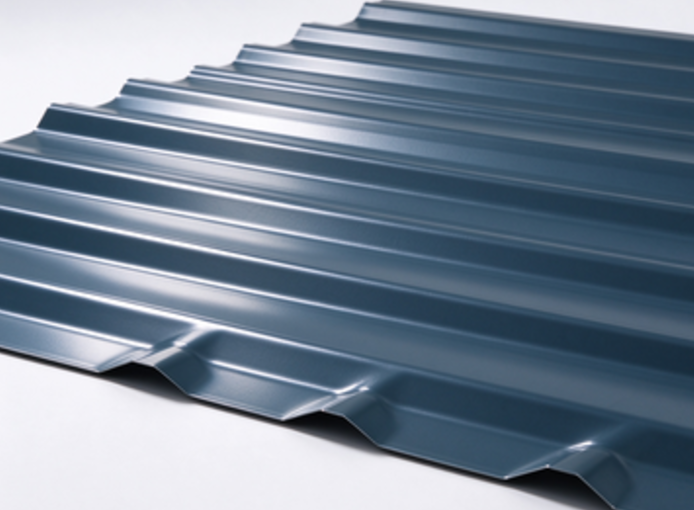
The profile choice also affects wind uplift resistance. Standing seam panels with tall, closely spaced ribs perform better under high wind loads. A profile with 43mm ribs and 233mm wide pans, for example, provides good wind uplift resistance and water-carrying capacity for low-slope applications.
What to Verify Before You Buy
The technical specifications above only matter if the material actually matches them. Here's what to check.
Mill Test Certificates. Every batch of coated steel should come with an MTC that traces back to the heat number from the steel mill. The certificate should show actual measured values for yield strength, tensile strength, elongation, zinc coating weight, and paint thickness. "Typical values" are not acceptable. You need measured results for the specific batch you're receiving.
Coating adhesion. The paint needs to stick. Adhesion is tested using methods like the X-Cut Tape Test per ASTM D3359, or bend and cupping tests per EN 13523. A supplier who can't provide adhesion test results is a supplier who hasn't verified the most fundamental quality parameter of a coated product.
Thickness tolerance. Base metal thickness tolerances matter for structural performance. For nominal thicknesses between 0.30mm and 0.50mm, the standard tolerance is typically ±0.03mm. For 0.51mm to 0.80mm, it's also ±0.03mm. If the incoming material measures outside those tolerances, the structural calculations you did for wind uplift are invalid.
A Real Project Lesson
A logistics company I worked with sourced color-coated steel roofing for a 40,000 square meter warehouse in Southeast Asia. The supplier quoted PE coating at a competitive price, and the samples looked good.
Two years after installation, the roof started showing significant color fade and chalking on the south-facing slopes. The PE coating had degraded faster than expected because the warehouse was located in an industrial zone with high atmospheric pollution. The combination of UV exposure and airborne chemicals accelerated the coating breakdown beyond what standard PE could handle.
The fix was expensive. The company had to re-coat the affected areas with a high-performance coating system that should have been specified from the start. The cost of the rework exceeded the original savings from choosing PE over HDP by a factor of three.
The lesson isn't that PE is a bad coating. It's that PE was the wrong coating for that specific environment. The spec sheet said PE had 7 to 8 years of life. The environment cut that in half. A proper site assessment would have flagged the industrial pollution exposure and pushed the specification toward SMP or HDP from the beginning.
Frequently Asked Questions
What's the difference between galvanized and galvalume, and which should I choose?
Galvanized is pure zinc. Galvalume is 55% aluminum, 43.5% zinc, and 1.5% silicon. Galvalume provides better corrosion resistance in acidic environments and at cut edges. Galvanized performs better in alkaline environments. For most roofing applications, galvalume is the superior choice unless the roof will be in contact with concrete or fresh mortar.
How do I know if the coating on my steel sheet is actually PVDF?
PVDF coatings contain at least 70% fluoropolymer resin. Ask for the resin content from the supplier's technical data sheet. If they can't provide it, the coating is probably not genuine PVDF. Some suppliers blend PVDF with acrylic to cut costs, which reduces performance.
Can I use the same steel sheet for roofing and wall cladding?
Usually, yes. The same coated steel substrate can be roll-formed into different profiles for roof and wall applications. The main difference is the profile — roof panels need to shed water, while wall panels are primarily aesthetic and weather-barrier functions.
What's the minimum thickness for a metal roofing sheet?
For residential applications, 0.40mm is typically the minimum acceptable thickness. For commercial and industrial roofs with longer spans or higher wind loads, 0.50mm to 0.60mm is more common. Metal tiles may go as low as 0.39mm in some markets.
How do I verify the zinc coating weight on incoming material?
Use a magnetic coating thickness gauge. Measure at multiple points across the coil width and length. The average should match the MTC. A deviation of more than 10% in either direction is a red flag.
The Bottom Line
Metal roofing steel sheet selection is a technical decision, not a purchasing decision. The substrate determines corrosion resistance. The coating determines appearance retention. The profile determines wind performance and maintenance requirements. Get any of those wrong, and the roof will fail before its time.
Verify the certificates. Test the adhesion. Check the thickness. And match the coating system to the actual exposure environment, not the lowest price quote.
If you're specifying metal roofing for a project and need help matching the substrate, coating, and profile to your specific conditions, send us the project details. We'll give you a straight answer on what the material needs to be.