
Introduction
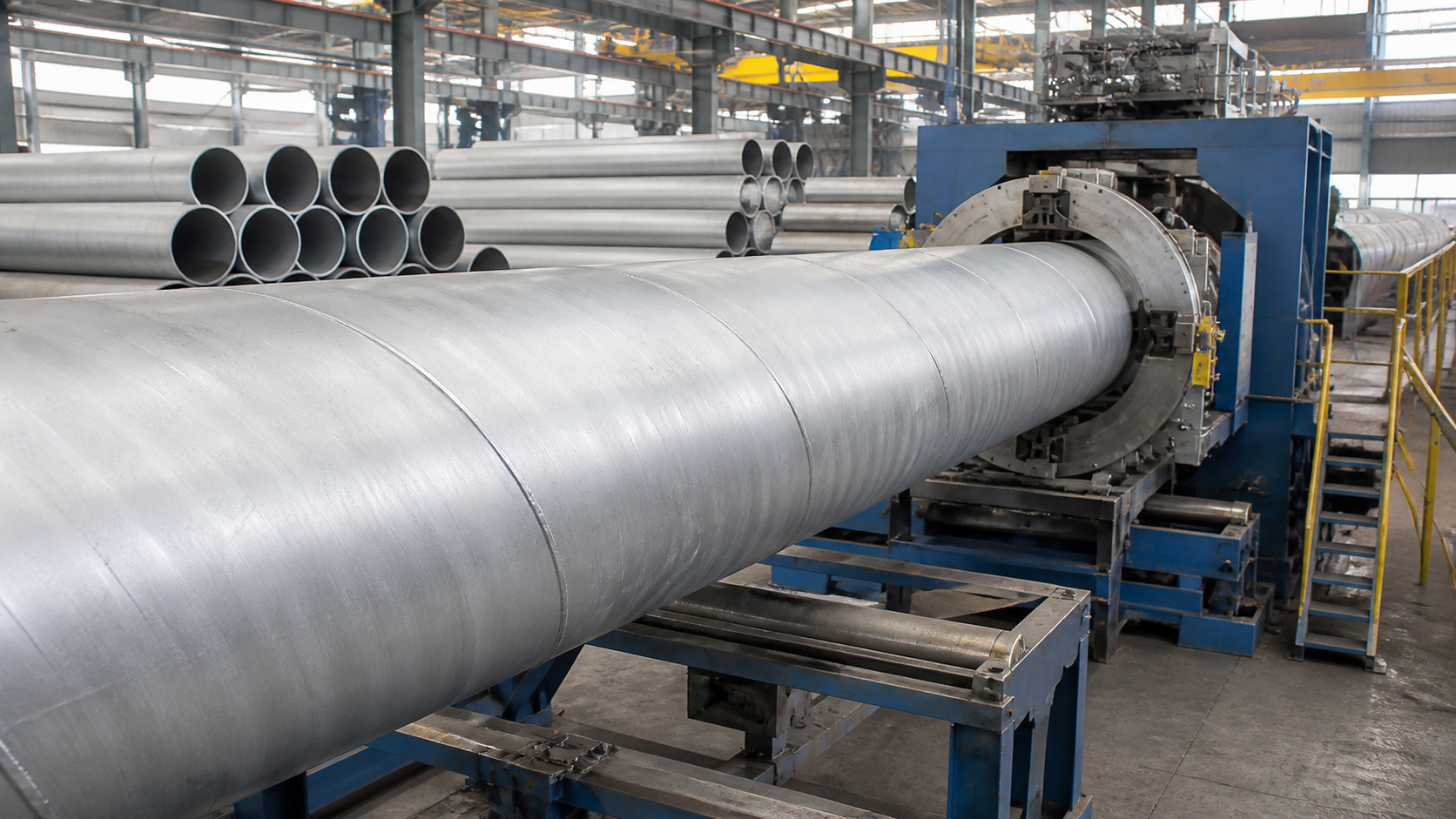
The manufacturing of hot-dip galvanized spiral welded pipes begins with flattened hot-rolled steel coils, which are cold-formed into a continuous spiral pipe blank, subsequently welded along the spiral seam using submerged arc welding, and finally hot-dip galvanized for corrosion protection. In North America, the entire production process conforms to ASTM A252, A53, and A139 standards; in other regions, it follows GB/T 9711 and EN 10219 standards. This is why qualified steel mills producing standard-compliant spiral welded pipes offer interchangeability in specification requirements.
Why Do Spiral Welded Pipes Use Coils Instead of Heavy Plates as Raw Material?
Spiral Submerged Arc Welded steel pipes (commonly abbreviated as SSAW) are manufactured using narrower hot-rolled steel coils rather than single heavy plates. This choice is the key to enabling economic and efficient production of large-diameter steel pipes: coils can be continuously fed into the forming unit for hours without stopping for material changes, whereas longitudinally welded pipes made from steel plates require reloading a new plate for every pipe produced.
The coil itself is a hot-rolled product, produced at temperatures above the recrystallization temperature of the steel, subsequently cooled and coiled, and then transported to the spiral pipe mill. All subsequent operations—forming, welding, sizing—take place at or near room temperature. Therefore, technically defined, spiral pipe forming is a cold-forming process performed on hot-rolled substrate, which shares the same process principles as cut-to-length and slitting lines that process coils into flat plates or strips.
Step-by-Step Breakdown: From Flat Coil to Round Pipe
Uncoiling and Strip Edge Preparation
After uncoiling, the coil is continuously fed into the unit, and the lead and tail ends of consecutive coils are joined by butt welding to ensure the production line operates without stopping. Before forming begins, the edges of the steel strip are machined by an edge milling machine to precise bevel angles, because the edge geometry directly determines the fit-up and fusion quality of both sides after the strip is coiled into a pipe shape.
Spiral Forming
The steel strip enters the forming head at a fixed feed angle. It is this feed angle, rather than merely the strip width, that determines the outer diameter of the finished steel pipe. As the strip spirals forward continuously, the leading edge of each turn meets the trailing edge of the previous turn, forming the spiral seam along which welding takes place. This is essentially a roll-forming process that follows the same dimensional control laws as all cold-roll forming: performing controlled, progressive bending and eliminating residual flat edge segments before the pipe is deemed to meet roundness specifications.
Internal and External Submerged Arc Welding (SAW)
Spiral welded pipes utilize a double-sided Submerged Arc Welding (SAW) process, where the arc is submerged under a granular flux layer during welding, resulting in clean, deep-penetration welds with minimal spatter. Because the weld seam extends in a spiral pattern rather than running straight along the pipe axis, the total weld length of a spiral welded pipe is typically 30% to 100% longer than that of a longitudinal seam pipe of equal length—a process trade-off made to continuously produce large-diameter pipes using relatively narrow coils.
Flying Saw Cut-off to Length
A trailing flying saw cut-off machine operates synchronously with the moving steel pipe, cutting the pipe into specified lengths without stopping the forming line, which enables the spiral pipe mill to operate continuously rather than in batches. The cut pipe sections are subsequently transferred off-line for subsequent inspection and finishing.
Weld and Dimensional Inspection
Each weld seam is inspected via Ultrasonic Testing (UT), Radiographic Testing (X-Ray), or a combination of both according to specific specifications and final applications; pressure-bearing pipelines also require full-length hydrostatic testing. Ovality, wall thickness, and straightness are all measured against tolerances permitted by applicable standards—these three metrics are likewise core criteria for measuring the quality of all cold-forming processes. Controlling ovality deviation to within approximately 1% of the pipe diameter and localized wall thinning to single-digit percentages of the nominal wall thickness are routine benchmarks for strict quality control on standard forming lines.
Sizing, End Facing, Beveling, and Final Inspection
The steel pipe passes through sizing rolls to correct minor out-of-roundness remaining from forming, and the pipe ends undergo facing and beveling to ensure perpendicularity to the axis for on-site fit-up welding or mechanical connection. Prior to transfer to the galvanizing process, final hydrostatic testing and visual inspection complete all production stages of the bare steel phase.
Hot-Dip Galvanizing: Transforming Bare Steel Pipes into Corrosion-Resistant Pipes
Galvanizing is an independent processing operation, not an ancillary byproduct of the pipe mill, and it follows the same basic principles as hot-dip galvanizing for other structural components. The steel pipe undergoes degreasing, acid pickling to remove scale and rust, rinsing, flux dipping, and drying before being completely immersed into a molten zinc bath. The zinc bath temperature is typically maintained between 450°C and 470°C, with zinc content controlled to at least 98.5%, and a small amount of aluminum added to promote the formation of a clean, well-bonded coating.
Because galvanizing is performed after the steel pipe is fully formed, welded, cut, and inspected (rather than being galvanized prior to forming like pre-galvanized coils), the zinc layer covers the entire finished pipe, including the cut end faces and the entire weld seam. This sequence of operations is more critical for pipes than for most other product categories, because in practical service, corrosion damage is most severe if coating gaps exist at cut end faces and weld seam locations.
Comparison Between Spiral Submerged Arc Welded Pipe (SSAW) and Longitudinal Welded Pipe
Comparison Factor | Spiral Submerged Arc Welded Pipe (SSAW) | Longitudinally Welded Pipe (LSAW / ERW) |
Starting Raw Material | Narrower hot-rolled coils | Wide heavy plates (LSAW) or coils (ERW) |
Production Method | Continuous production; coils joined end-to-end | Batch production (heavy plates) or continuous (small-diameter coils) |
Total Weld Length Per Pipe | Increased by 30%–100% (spiral weld) | Shorter (single longitudinal straight weld) |
Practical Applicable Diameter Range | Capable of producing extra-large diameters using narrower coils | Large diameters require correspondingly extra-wide heavy plates |
Typical Application Scenarios | Pipe piles, water/gas main pipelines, structural columns | High-pressure transmission pipelines, critical structural load-bearing components |
Cost Advantage at Large Diameters | Overall more cost-effective | Heavy plate costs and handling expenses increase significantly with diameter |
Practical Application Fields of Hot-Dip Galvanized Spiral Welded Pipes
Steel pipe piling is the application most closely associated with the ASTM A252 spiral welded pipe standard, commonly used in foundation engineering, marine engineering structures, and retaining walls, where the steel pipe itself serves as a load-bearing driven pile or drilled shaft. In these applications, galvanizing significantly extends service life, as pipe piles remain in continuous contact with soil or water throughout the structure's lifespan with almost no opportunity for repainting maintenance.
Water, gas, and general fluid transmission pipelines represent another major application area, where lower-pressure service follows the ASTM A139 standard, and oil and gas transmission specifications follow the API 5L standard. In addition, hot-dip galvanized spiral welded pipes are widely used in structural columns, guardrail posts, and agricultural infrastructure—scenarios where using coils to produce large-diameter corrosion-resistant pipes is far more economical than using heavy plates.
Frequently Asked Questions (FAQ)
1. Is the strength of a spiral seam welded pipe as high as that of a longitudinal seam welded pipe?
Yes. When produced according to the same governing standards, the spiral weld seam itself does not reduce the strength of the steel pipe. Strength depends on steel grade, wall thickness, and weld quality; regardless of seam direction, the specifications and inspection methods for these indicators remain consistent.
2. Why is the weld length of a spiral welded pipe longer than that of a longitudinal welded pipe?
Because the weld seam follows a spiral path along the steel pipe rather than running straight axially, a pipe of the same length requires a proportionally longer linear weld to complete closure. This is a direct process trade-off made to continuously produce large-diameter pipes using coils that are much narrower than the pipe circumference.
3. Does galvanizing after welding cause issues at the weld seam?
No, provided that the weld seam has passed quality inspection. The molten zinc does not distinguish between base metal and weld metal—as long as the surface is clean and properly fluxed, it will cover uniformly. This is precisely why galvanizing after complete fabrication (rather than before processing) provides superior protection for welded products.
4. What determines the finished pipe diameter on a spiral pipe mill?
It is determined by the forming angle at which the coil enters the forming head, not by the coil width. The same coil width can produce steel pipes of different diameters by adjusting the feed angle, which is one of the reasons why a spiral pipe mill can cover a wide range of pipe diameters using a limited number of coil specifications.
Conclusion: Select Spiral Welded Pipes Based on Process, Not Merely Price
The manufacturing process is what truly determines whether a hot-dip galvanized spiral welded pipe meets specified performance requirements: the quality of the raw material coil, the forming control of the mill unit, weld seam integrity verified through genuine testing (rather than relying solely on a certificate), and galvanizing executed after fabrication (rather than before). These process details are far more important than the basic content shown in standard specifications, and they are worth requesting the supplier to explain in detail during procurement, rather than assuming that all spiral welded pipes with similar quotes are manufactured to the same standard.
*Part of the above processes referenced from our company's Process Manual.