
Introduction
When procurement managers source galvanized pipe, they are rarely looking for just an off-the-shelf commodity. They need a reliable material solution that can withstand environmental exposure, meet project specifications, and maintain consistent quality throughout fabrication and installation.
For companies sourcing galvanized steel pipe from China, supplier capability is just as important as product specifications. A professional galvanized pipe supplier in China should provide stable material sourcing, quality inspection, processing support, and reliable delivery coordination.
In real industrial purchasing, the lowest quotation does not always represent the lowest overall project cost. Poor coating quality, unsuitable material selection, or inconsistent dimensions can lead to additional fabrication work, installation issues, and unexpected expenses later in the project lifecycle.
This is why experienced buyers usually evaluate more than price. They consider steel grade, pipe structure, galvanizing quality, processing capability, and whether the supplier can support the project from material selection to final shipment.
This guide explains how galvanized pipe works, how to select the right type for different applications, and what international buyers should check before placing bulk orders.
Table of Contents
1. What Is Galvanized Pipe and Why Is It an Industry Standard?
2. How Hot-Dip Galvanizing Improves Steel Pipe Durability
3. Choosing the Right Type of Galvanized Pipe for Different Applications
4. Key Quality Factors Before Bulk Purchasing
5. Galvanized Pipe Material and Application Comparison
6. Real Industry Application Example
7. How to Select a Reliable Galvanized Pipe Supplier in China
What Is Galvanized Pipe and Why Is It an Industry Standard?
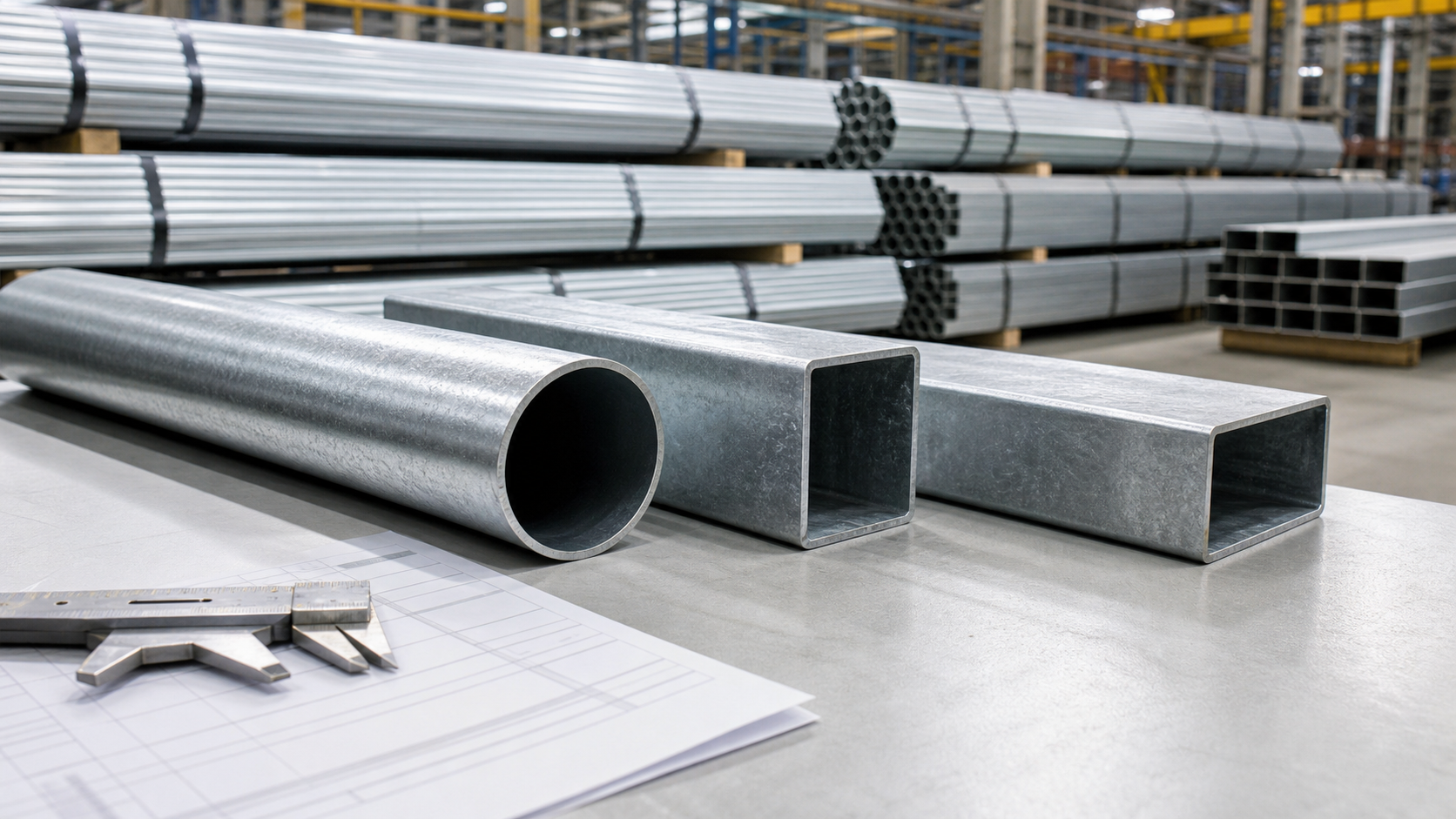
Galvanized pipe is a steel pipe protected with a zinc coating to improve corrosion resistance and extend service performance in demanding environments.
Unlike untreated carbon steel, galvanized steel pipe features an integrated zinc coating that acts as a resilient barrier against moisture, oxygen, and corrosive agents.
This combination of structural strength and corrosion protection makes galvanized pipe a practical choice for many industrial and construction applications, including:
· Steel structure projects
· Building frameworks
· Industrial support systems
· Mechanical fabrication
· Outdoor structures
· General engineering applications
For many projects, the biggest advantage of galvanized pipe is not only its strength but also its ability to reduce maintenance requirements compared with untreated steel products.
However, selecting the right galvanized pipe is not simply about choosing a product with a zinc coating. The pipe specification, steel grade, coating quality, and application environment all influence the final performance.
How Hot-Dip Galvanizing Improves Steel Pipe Durability
Understanding the Hot-Dip Galvanizing Process
Hot-dip galvanizing remains the industry-benchmark method for maximizing steel corrosion resistance.
During this process, steel products are cleaned and immersed into molten zinc. At high temperatures, the zinc reacts with the steel surface and forms a protective coating layer.
This zinc coating provides dual-action protection:
1. Barrier Protection
The coating separates the steel surface from direct contact with moisture and oxygen, helping reduce corrosion risk.
2. Sacrificial Protection
Zinc is more reactive than steel, meaning it can provide additional protection even when minor surface damage occurs.
For industrial buyers, coating uniformity and thickness are critical quality indicators. A uniform zinc coating helps ensure predictable performance across the entire pipe surface.
A reliable supplier should pay attention not only to the steel pipe itself but also to the galvanizing process and final surface inspection.
Choosing the Right Type of Galvanized Pipe for Different Applications
Different projects require different pipe structures. Selecting the correct type helps improve both performance and cost efficiency.
Galvanized Round Pipe
Galvanized round pipe is one of the most commonly used steel pipe types.
Its circular geometry promotes uniform load distribution, making it suitable for:
· Structural supports
· General construction applications
· Industrial frameworks
· Outdoor projects
For projects requiring standard structural performance and corrosion protection, round galvanized pipe is often a practical choice.
Galvanized Square Pipe
Galvanized square pipe has a rectangular hollow section, making it especially suitable for fabrication and structural assembly.
Typical applications include:
· Steel frames
· Equipment supports
· Building structures
· Customized fabrication projects
Compared with round pipe, square pipe is often easier to connect and fabricate in certain structural applications.
Welded Galvanized Pipe
Welded galvanized pipe is engineered by continuously forming steel strips into a cylindrical shape and welding the longitudinal seam, often using electric resistance welding (ERW). This process supports consistent dimensional tolerances and cost-effective production for construction, general engineering, and fabrication applications.
Engineers and contractors prioritize this pipe type for its distinct operational benefits:
· Consistent dimensions
· Efficient production
· Flexible application options
For general engineering and construction projects, welded galvanized pipe provides a practical balance between performance and cost.
Key Quality Factors Before Bulk Purchasing
When purchasing galvanized pipe in large quantities, experienced buyers usually evaluate several important factors before confirming an order.
1. Steel Grade Verification
The steel grade directly affects mechanical performance.
Before bulk purchasing, buyers should confirm:
· Material specification
· Mechanical requirements
· Application requirements
The selected steel should match the actual project conditions rather than simply choosing the lowest-cost option.
2. Dimensional Accuracy
Pipe dimensions directly influence fabrication and installation.
Important measurements include:
· Outer diameter
· Wall thickness
· Length
· Shape consistency
Even small dimensional differences can create difficulties during assembly, especially in large construction projects.
3. Surface and Coating Quality
For galvanized products, surface quality is one of the most important inspection points.
Buyers should check:
· Zinc coating thickness and uniformity
· Surface appearance
· Visible defects
· Coating damage during handling
A controlled galvanizing process should provide uniform coverage and the specified coating thickness across the entire product surface.
4. Packaging and Transportation
International steel shipments often travel long distances before reaching the final destination.
Proper packaging helps protect galvanized pipe from:
· Transportation damage
· Surface scratches
· Improper handling conditions
A supplier with experience in international logistics can help reduce delivery risks.
Galvanized Pipe Material and Application Comparison
Product Type | Main Characteristics | Typical Applications |
Galvanized Round Pipe | High structural load capacity with enhanced corrosion resistance | Construction supports, industrial structures, outdoor applications |
Galvanized Square Pipe | Easy fabrication and convenient structural connection | Frames, supports, customized steel structures |
Welded Galvanized Pipe | Consistent dimensions and cost-effective production | Construction, general engineering, and fabrication projects |
Real Industry Application Example
Outdoor industrial structures provide a good example of why galvanized pipe is widely selected.
Projects such as warehouse extensions, equipment support systems, and outdoor steel frameworks often face continuous exposure to humidity, temperature changes, and environmental conditions.
In these situations, corrosion resistance becomes an important factor during material selection.
The World Steel Association identifies steel as one of the most widely used engineering materials globally, supporting industries such as construction, infrastructure, transportation, and manufacturing.
For steel structures exposed to outdoor conditions, galvanized products are commonly considered because the zinc coating provides additional protection compared with untreated steel.
The practical lesson is clear: choosing the correct steel product is only one part of the solution. Processing quality, coating thickness and uniformity, and supply reliability also influence the final project result.
How to Select a Reliable Galvanized Pipe Supplier in China
For international buyers, supplier evaluation should go beyond product availability and price.
A capable galvanized pipe supplier should provide:
· Stable steel sourcing channels
· Clear product specifications
· Quality inspection support
· Processing capability
· Professional shipment coordination
Shanghai Banzhijia Supply Chain provides integrated steel supply solutions covering material sourcing, storage, processing coordination, and delivery support.
Looking for a Reliable Galvanized Pipe Partner in China?
Shanghai Banzhijia helps customers manage steel procurement requirements through coordinated supply solutions, including product selection, processing support, and shipment arrangements.
For projects requiring galvanized steel pipe or customized steel solutions, working with a professional supply partner can help reduce procurement complexity and improve project efficiency.
Contact Our Engineering Team for a Customized Steel Solution
Frequently Asked Questions
1. What is the difference between galvanized pipe and regular steel pipe?
The main difference is the zinc coating. Galvanized pipe has an additional protective layer that improves corrosion resistance compared with untreated steel pipe.
2. What types of galvanized pipe are commonly used?
Common types include galvanized round pipe, galvanized square pipe, and welded galvanized pipe. The best choice depends on application requirements, structural design, and fabrication needs.
3. Can galvanized pipes be customized before shipment?
Yes. Depending on project requirements, processing services such as cutting and other preparation work can be arranged before delivery.
4. What should buyers check before importing galvanized pipe?
Buyers should verify:
· Steel grade
· Pipe dimensions
· Zinc coating quality
· Inspection requirements
· Packaging methods
· Supplier processing capability
Careful evaluation before purchasing helps reduce risks during installation and project execution.
Final Thoughts
Choosing galvanized pipe is not simply a matter of comparing prices. Successful procurement requires the right combination of material selection, coating quality, processing capability, and supply chain reliability.
For construction companies, engineering contractors, and industrial buyers, a dependable supplier can help reduce uncertainty from sourcing to final installation.
If you are sourcing galvanized steel pipe, galvanized square pipe, or customized steel solutions, Shanghai Banzhijia can support your project with professional supply coordination and processing services.