
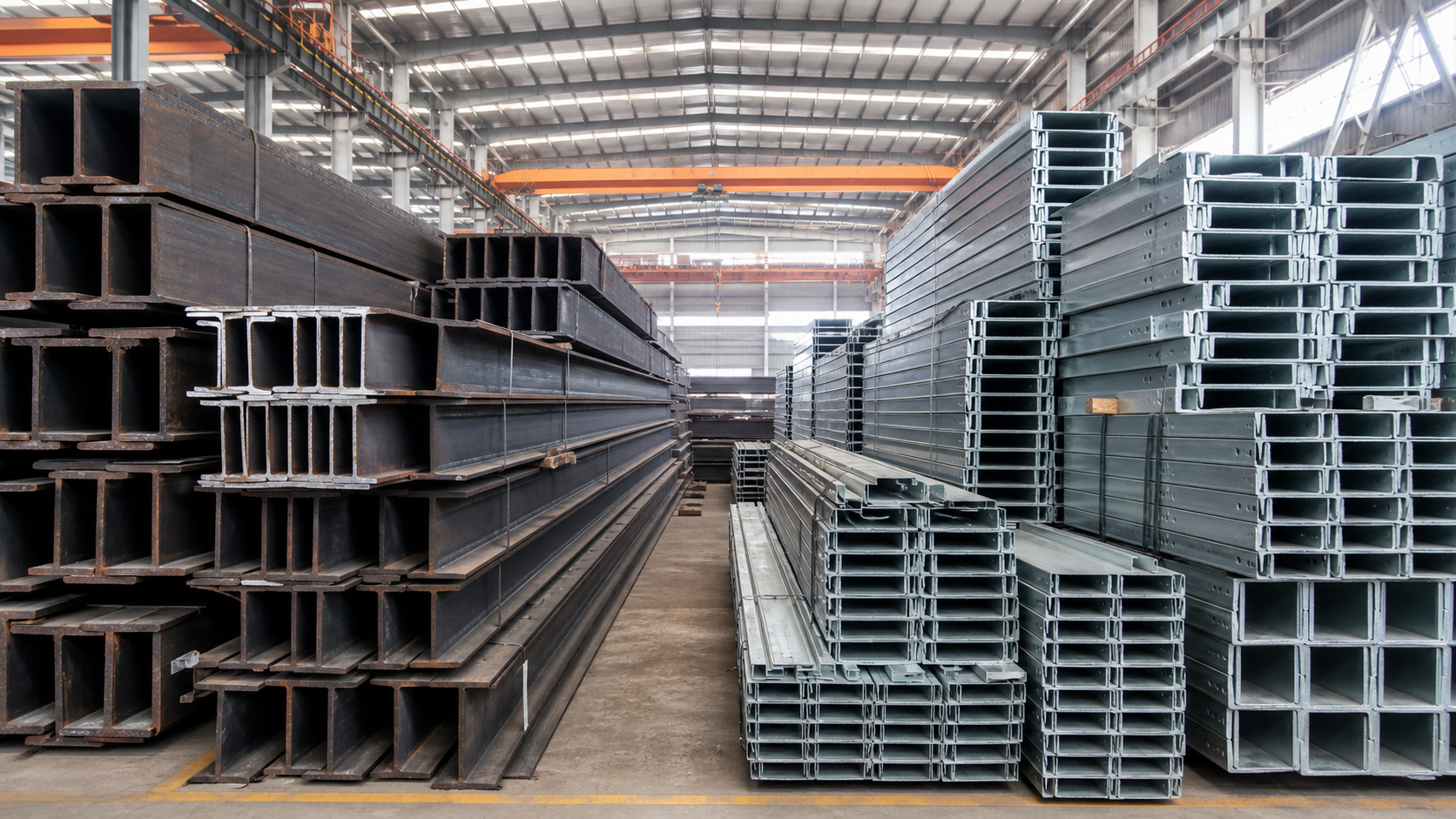
Everything that separates hot rolled steel from cold formed steel traces back to one number: roughly 925°C (1,700°F), the recrystallization temperature of steel. Roll it above that line and the material stays soft and workable, coming out with a rough, scaled surface and looser dimensional tolerance. Roll or form it below that line — at room temperature — and the steel work-hardens as it's shaped, gaining strength and a clean surface finish at the cost of needing more force to move it.
That single distinction cascades into almost every practical difference buyers and fabricators actually care about: what the surface looks like, how tightly a part can be toleranced, what the steel costs, and which structural role it's suited for.
Where the Line Actually Sits
Hot rolling happens above steel's recrystallization threshold, generally cited around 925°C (1,700°F), though the practical range for structural steels runs from roughly 720°C to 1,260°C depending on alloy. At that temperature the steel is soft enough to shape with relatively little force, and any internal stress introduced by rolling gets relieved as the material cools slowly afterward.
Cold forming — which includes cold rolling, leveling, roll forming, and slitting — happens below that threshold, almost always at or near room temperature, and almost always on steel that has already been hot rolled once. There's no second heating step to relieve the stress this time, so the shaping itself changes the metal's internal structure permanently.
What Changes When Steel Crosses That Line
Surface finish is the most visible difference. Hot rolled steel cools with a layer of iron oxide — mill scale — bonded to the surface, giving it a rough, matte gray texture that has to be removed by pickling or shot blasting before certain downstream processes will work on it. Cold formed and cold rolled steel skips that scale formation entirely, coming out smooth, often with a slight sheen.
Dimensional control moves in the opposite direction from what people expect. Hot rolled steel cools unevenly after leaving the mill, and that uneven cooling introduces warping and thickness variation that's hard to fully control — which is exactly why hot rolled coil almost always needs a leveling pass before it becomes usable flat sheet. Cold forming operations, by contrast, are typically capable of holding tolerances several times tighter, simply because there's no thermal contraction working against the equipment.
Strength tells the opposite story from ductility. Cold working increases yield strength and hardness through strain hardening — sometimes significantly — but it reduces the material's ability to deform further without annealing. Hot rolled steel keeps more of its natural ductility, which is part of why it remains the default choice for structural members that need to absorb load without cracking.
Cost, in short, follows directly from process complexity: hot rolling requires fewer processing steps and less precision equipment, so it's consistently the less expensive option per unit weight, even before cold forming's additional tolerance and finish requirements are factored in.
Hot Rolled vs. Cold Formed Steel at a Glance
Property | Hot Rolled | Cold Formed / Cold Rolled |
Forming temperature | Above ≈925°C (1,700°F) | Room temperature (below recrystallization point) |
Surface finish | Rough, scaled (mill scale) | Smooth, often slightly polished |
Dimensional tolerance | Wider; some warping from uneven cooling | Tighter; no thermal distortion |
Internal stress | Low (relieved during slow cooling) | Higher (locked in by strain hardening) |
Strength / hardness | Lower yield strength, higher ductility | Higher yield strength and hardness |
Relative cost per ton | Lower | Higher |
Typical structural role | Load-bearing members, heavy sections | Precision parts, thin-gauge components |
From Coil to Finished Flat Stock: Where Leveling and Slitting Fit In
Neither hot rolled nor cold rolled coil arrives at a fabricator ready to use. Both still need to be uncoiled, straightened, and cut to a usable size — and that step is itself a cold-forming operation, regardless of which way the original coil was produced.
Cut-to-Length: Turning Coil Into Flat Sheet
A cut-to-length (leveling) line takes a coil, straightens it through a multi-roll leveler to remove the curvature and internal stress the coil picked up during winding, then shears it to a specified length and stacks the finished sheets. Per our in-house cut-to-length process manual, a standard line handles material from 0.3 mm to 25 mm thick and 500 mm to 2,000 mm wide, cutting to lengths between 500 mm and 12,000 mm.
Parameter | Specification |
Processing thickness range | 0.3 – 25 mm |
Processing width range | 500 – 2,000 mm |
Cut length range | 500 – 12,000 mm |
Length tolerance | ±0.5 mm / ±1.0 mm |
Diagonal tolerance | ≤2.0 mm/m² |
Flatness | ≤3 mm/m² |
Shearing burr | ≤5% of plate thickness |
Line speed | 0 – 60 m/min |
Flatness and tolerance are where hot rolled and cold rolled feedstock actually behave differently on this equipment. Hot rolled coil generally carries more residual curvature and surface scale, so the leveler needs more aggressive roll penetration to bring it within tolerance; cold rolled coil arrives flatter to begin with and typically holds the tighter end of that tolerance band with less correction.
Slitting: Turning Wide Coil Into Precision Strip
A slitting line does the opposite kind of cutting — instead of shortening the coil, it divides the width into several narrower strips using circular disc shears, then tensions and recoils each strip separately. Per the same process manual, a standard slitting line processes 0.2 mm to 12 mm material, 500 mm to 2,000 mm wide, producing slit widths from 20 mm down to 10 mm at the narrow end, in up to 30 strands from a single coil.
Parameter | Specification |
Processing thickness range | 0.2 – 12 mm |
Raw material width range | 500 – 2,000 mm |
Slit width range | 20 – 1,800 mm (down to 10 mm minimum) |
Width tolerance | ±0.1 – ±0.5 mm |
Number of slit strands | Up to 30 |
Shear blade diameter | Φ200 – Φ350 mm |
Blade clearance | 5% – 12% of plate thickness |
Line speed | 0 – 120 m/min |
Maximum coil weight | 30 tons |
Blade clearance is the setting that matters most here, and it isn't fixed — the manual specifies 5% to 12% of plate thickness, adjusted for material grade, because a clearance set for soft cold rolled strip will tear rather than shear a harder, thicker hot rolled coil.
Matching Process to Application
Hot rolled steel's natural home is anywhere a structure needs to carry load without needing a polished appearance: structural beams and channels, rebar, large-diameter pipe, railroad rail, and heavy agricultural and construction equipment frames all draw on hot rolled steel's combination of ductility, larger available sizes, and lower cost per ton.
Cold formed and cold rolled steel does the opposite job well. Automotive body panels, appliance housings, precision stamped brackets, and HVAC ductwork all depend on the tight tolerance and clean surface finish cold forming provides. A large share of light-gauge structural framing — studs, track, and purlins — is also cold-formed, closely enough to standardized industry practice that the American Iron and Steel Institute maintains a dedicated design specification, AISI S100, covering exactly this category of product. Slit strip, in particular, is the direct feedstock for tube and pipe mills, where the strip's width tolerance carries straight through to the consistency of the finished weld seam.
Common Questions
Can hot rolled coil be cold-formed later?
Yes — this is actually the normal production sequence rather than an exception. Most cold rolled and cold formed steel starts life as hot rolled coil, which is pickled to remove mill scale and then cold reduced, leveled, or slit to reach its final specification.
Does cold rolling always produce a stronger part than hot rolling?
Generally yes in terms of yield strength and hardness, but that strength comes from strain hardening, and it reduces remaining ductility unless the material is subsequently annealed. Whether that trade-off is worthwhile depends entirely on whether the application needs strength or needs to flex without cracking.
What tolerance can a slitting line actually hold?
Per a standard process manual, width tolerance on slit strip typically runs ±0.1 mm to ±0.5 mm depending on material thickness and width, with the tighter figure applying to thinner, narrower cuts.
Is hot rolled steel always cheaper than cold formed steel?
On a per-ton basis, essentially always — hot rolling requires fewer processing steps and less precision tooling. Once a project needs the tolerance, finish, or strength that only cold forming provides, though, comparing the two on price alone stops being a meaningful comparison.
Closing
Neither process is the better one in the abstract. The recrystallization line that separates them is also the line that separates their entire set of trade-offs, and the right choice depends on what the finished part actually needs to do. For fabricators working directly from coil, that decision extends past the raw material into how the leveling and slitting equipment itself gets configured for the specific stock being run. A process engineering review — matching line settings to the actual coil specification, hot rolled or cold rolled — is worth doing before a production run, not after tolerance problems show up on the shop floor.