
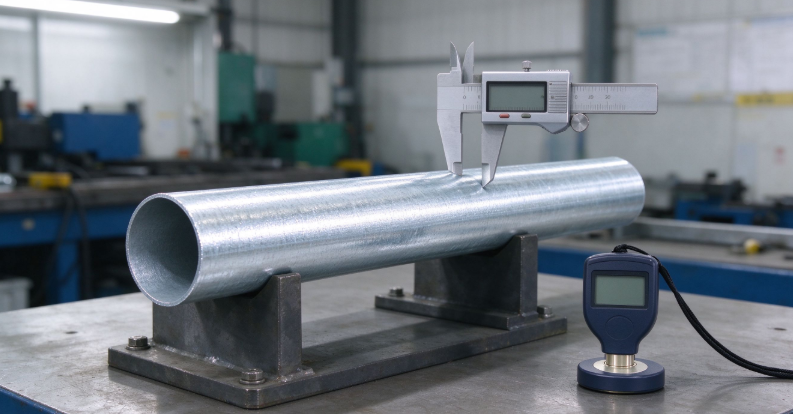
A purchase order that says only 'galvanized round pipe' leaves too much open to interpretation. The supplier still needs to know the required diameter, wall thickness, steel grade, pipe manufacturing route, coating requirement, end preparation and delivery documents. If any of these are missing, two quotations may look comparable while describing different products.
This guide follows the questions a project engineer or steel buyer should settle before requesting a price. It is written for general industrial and construction procurement; where a pipe is intended for a regulated pressure, potable-water or fire-protection system, the governing project code and approval requirements take priority.
Contents
· Start with the pipe's actual duty
· Define diameter, wall thickness and length
· Choose the steel grade and manufacturing route
· Specify the zinc coating correctly
· Plan inspection and documentation
· A worked procurement example
· Frequently asked questions
Start with the Pipe's Actual Duty
Before discussing dimensions, describe what the pipe will do. A round pipe used as a fence post is a structural member. A pipe carrying water or gas is a pressure or service-line component. A pipe supporting a curtain-wall assembly has its own load path and connection requirements. The same outside diameter does not make these duties interchangeable.
The New Plate Steel product listing places galvanized steel pipe in its Pipes & Tubes range and identifies water, gas, fire-fighting and structural uses. The parent company's product handbook also names outdoor fencing, curtain-wall framing, ventilation ducts and fire-sprinkler systems. These examples help define the market context, but the buyer must state the exact service and applicable code rather than relying on a broad application label.
Define Diameter, Wall Thickness and Length
For a circular pipe, outside diameter and wall thickness are the first dimensional controls. The outside diameter affects connection fit and structural geometry. Wall thickness affects section capacity, handling robustness and, for fluid service, the available internal diameter. Length affects transport, cutting plans, joint count and site installation.
Do not assume nominal size is the same as a measured outside diameter. In standards-based pipe systems, nominal pipe size is a designation, while actual dimensions are defined by the relevant dimensional tables. The purchase specification should name the standard and schedule or give the required dimensions and tolerances directly.
Dimension / detail | What to put in the enquiry | Why it matters |
Nominal size or outside diameter | State the nominal designation and, where needed, the required measured OD. | Prevents confusion between nominal designation and actual geometry. |
Wall thickness / schedule | State the schedule or nominal wall thickness and the tolerance basis. | Affects strength, mass, internal bore and connection compatibility. |
Cut length | State fixed length, random length range or project-specific cut lengths. | Controls fabrication, waste, shipping and installation planning. |
End preparation | Plain end, threaded end, grooved end, bevel or another defined finish. | Must match couplings, fittings, welding procedures and site assembly. |
Dimensional tolerances | Cite the governing product standard or list agreed tolerances. | Gives the receiving inspector an objective acceptance basis. |
If the pipe is part of a structural frame, the engineer should also define design loads, support spacing, connection eccentricity and allowable deflection. If it carries fluid, the line designer should specify design pressure, temperature, medium, flow requirements and joining method. A pipe supplier cannot infer these conditions from diameter alone.
Choose the Steel Grade and Manufacturing Route
The material grade should follow the governing design or piping standard. Welded pipe is commonly produced from formed strip or plate with a longitudinal seam; seamless pipe is made without a welded seam. Neither label by itself proves that a product is suitable for a particular duty. The standard, grade, dimensions, test requirements and manufacturing controls have to match the specification.
ASTM A53/A53M-24 is a useful example of a pipe product specification: it covers welded and seamless steel pipe, including hot-dip zinc-coated pipe, and identifies Type F, Type E and Type S manufacturing categories. Its scope describes mechanical and pressure applications and ordinary uses in steam, water, gas and air lines, subject to the standard's qualifications. If a project calls for ASTM A53, the purchase order should state the required grade and type rather than merely writing 'ASTM pipe'.
The Shanghai Banzhijia product handbook separately describes its general welded round pipe range as using Q235B and Q355B carbon structural steel, with flexible sizes and non-standard processing available. That description applies to the handbook's welded round pipe category. It should not be automatically transferred to every galvanized pipe item without a product-specific grade confirmation.
Specify the Zinc Coating, Not Just the Word 'Galvanized'
The coating requirement needs its own line in the enquiry. Buyers should identify the galvanizing route, applicable coating standard, required coating thickness or mass where specified, test method, sampling plan and repair procedure for damaged areas. The supplier should confirm whether the pipe is galvanized on a dedicated pipe line or whether a fabricated item is galvanized after fabrication.
This distinction matters because standards are not interchangeable. ASTM A53/A53M-24 is a pipe specification that includes hot-dip galvanized pipe. ASTM A123/A123M addresses hot-dip galvanized coatings on iron and steel products such as structural shapes and fabrications, while the American Galvanizers Association notes that A123 does not govern pipe or tube galvanized on specialized or continuous lines. ISO 1461:2022 also excludes pipe and tube hot-dip galvanized in automatic plants from its scope. The correct reference must therefore be selected for the actual product and process.
Reference | Main scope in this context | Procurement implication |
ASTM A53/A53M-24 | Welded and seamless steel pipe, including hot-dip zinc-coated pipe. | Potentially relevant when the project specifies pipe to ASTM A53; confirm grade, type and ordered requirements. |
ASTM A123/A123M-24 | Hot-dip galvanized coatings on iron and steel products such as structural shapes and fabrications. | Do not apply it automatically to pipe galvanized on a specialized or continuous pipe line. |
ISO 1461:2022 | Hot-dip galvanized coatings on fabricated iron and steel articles. | Its scope excludes pipe and tube galvanized in automatic plants; use the relevant pipe/product standard. |
The internal Shanghai Banzhijia processing manual describes a general hot-dip galvanizing workflow: degreasing, pickling, rinsing, fluxing, drying, immersion in molten zinc, cooling and inspection. It also gives general process reference values, including a zinc-bath temperature range of 450–470°C. These are process-guide values from the supplied manual, not a declared specification for the New Plate Steel galvanized round-pipe SKU. They should not be copied into a purchase order unless the actual production route and supplier confirm that they apply.
Inspection Should Connect the Requirement to Evidence
A coating requirement is useful only when the parties agree how it will be verified. Visual inspection can identify bare spots, handling damage, roughness, runs or other surface conditions, but appearance alone cannot establish coating thickness or pipe mechanical properties.
Inspection point | What is being checked | Typical evidence / method to agree |
Visual condition | Coating continuity, visible bare areas, damage, excessive deposits and end condition. | Defined visual acceptance criteria and inspection record. |
Coating thickness | Whether the zinc layer meets the agreed requirement. | Calibrated magnetic or other specified gauge; agreed sampling locations and frequency. |
Pipe dimensions | Outside diameter, wall thickness, length and end geometry. | Calibrated dimensional tools and a recorded inspection plan. |
Mechanical / pressure tests | Conformance with the ordered pipe product standard. | Applicable mill test results and test certificates, such as those required by the specified standard. |
Traceability | Whether delivered bundles can be linked to production and inspection records. | Bundle tags, heat or batch number, MTC and packing list. |
ASTM A53/A53M-24's published scope summary identifies tension, bend and flattening tests, as well as hydrostatic and nondestructive electric testing, for the relevant pipe types and requirements. The exact tests and acceptance criteria depend on the ordered type and standard text. Buyers should request the actual certificate and verify that it corresponds to the delivered material, not accept a generic company certificate as a substitute.
The processing manual also emphasizes checking coating appearance, thickness, adhesion and corrosion performance for surface-treatment work, and recording the corrosion-protection method, coating thickness and inspection results. For galvanized pipe, use the inspection requirements applicable to the pipe standard and the agreed coating specification; do not assume a generic salt-spray duration alone predicts years of field life.
A Worked Procurement Example
Suppose a contractor needs galvanized round pipe for a new outdoor fence around a distribution warehouse. The first request to suppliers is simply 'galvanized round pipe, please quote'. One supplier prices a lighter wall, another quotes a different length, and a third assumes a different coating route. The totals cannot be compared fairly.
The contractor revises the enquiry to include the fence drawing, post spacing, design loads, required outside diameter, wall thickness, cut length, steel grade, coating standard or agreed coating requirement, end condition, quantity, destination and required documents. The contractor also states whether any cutting, drilling or welding will take place after delivery and how repaired areas should be treated.
This is a worked procurement scenario rather than a report of a named project. It shows why the specification should be complete before price comparison. For structural use, a qualified engineer must still approve the member sizing and connection design; the example is not a substitute for structural calculations.
How to Prepare a Clear RFQ
· Attach the drawing or a dimensioned schedule, including outside diameter, wall thickness and length.
· State the required steel grade, pipe type and governing product standard.
· Define the galvanizing route and coating acceptance requirement, including test method where applicable.
· Specify end preparation, threading or grooving, and any post-galvanizing fabrication.
· State quantity, bundle or packing requirements, delivery destination and required delivery term.
· List the documents required at dispatch, such as the mill test certificate, inspection record, certificate of origin and packing list, where applicable.
New Plate Steel's website states that order-specific mill test certificates and export documents can be provided according to the order and destination requirements. The site also notes that minimum order quantity and lead time depend on product specification and stock status. For this reason, a complete RFQ is usually the quickest way to obtain a meaningful confirmation rather than a broad price indication.
Frequently Asked Questions
What is the most important dimension when ordering galvanized round pipe?
There is no single dimension that works independently. Outside diameter, wall thickness and length must be specified together, with the nominal designation and dimensional standard made clear.
Is a thicker zinc coating always better?
Not automatically. The required coating depends on the product standard, exposure, fabrication details and project acceptance criteria. A coating should meet the agreed specification and remain suitable for the pipe's intended service and connection method.
Can I use ASTM A123 for galvanized steel pipe?
Do not assume so. A123 covers many hot-dip galvanized iron and steel products, but it excludes pipe and tube galvanized on specialized or continuous lines. For pipe, identify the pipe product standard and the coating requirements within that standard or the project specification.
What is the difference between a mill test certificate and a coating inspection report?
A mill test certificate records material-related information and test results required by the relevant product standard. A coating inspection report records the specified surface-treatment checks, such as coating thickness or visual condition. The exact document names and contents vary by standard and supplier; confirm both sets of evidence when the project requires them.
What if the pipe will be cut or welded on site?
Include that information in the RFQ. Cutting and welding can damage the zinc layer locally, and welding galvanized steel requires appropriate fume controls. The project specification should define the approved repair method and inspection after repair.
Conclusion
A sound galvanized steel round pipe specification connects the pipe's job to its dimensions, grade, manufacturing route, zinc coating and inspection records. That is what allows engineers to assess suitability and buyers to compare quotations on the same basis.
When requesting a quotation from New Plate Steel, provide the drawing, application, destination and required standard alongside the quantity. The product team can then confirm which galvanized steel pipe option and supporting documents match the order requirements.