
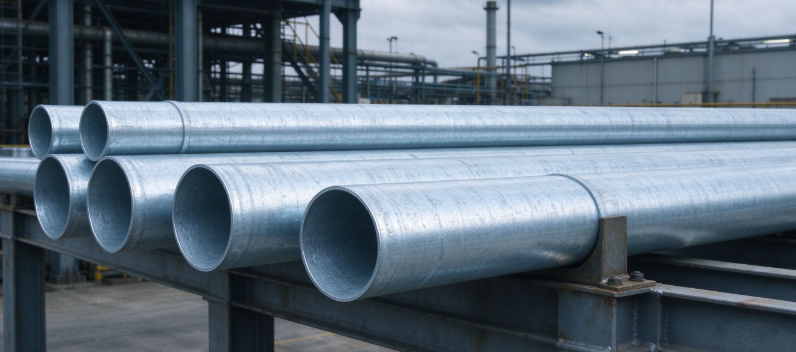
A steel pipe can have the right diameter and wall thickness and still become a maintenance problem if its surface protection is not suited to the environment. That is why galvanized steel round pipe remains a practical material for outdoor structures, building services and a range of industrial installations. The zinc layer does more than give the pipe a bright metallic finish: it helps isolate the steel from the atmosphere and can provide sacrificial protection where the coating is locally damaged.
For a buyer, however, the useful question is not simply whether a pipe is galvanized. It is how the pipe was made and coated, what exposure it will face, and whether the supplied product can be checked against the project specification. Those details determine whether the material is a sensible choice for the job.
Contents
· What galvanized steel round pipe is
· How the zinc layer protects the steel
· What affects corrosion performance in service
· Where galvanized round pipe is used
· A practical project example
· What to verify before ordering
· Frequently asked questions
What Is Galvanized Steel Round Pipe?
Galvanized steel round pipe is a hollow, circular steel product with a zinc-based protective coating on its surface. The circular section is useful where the pipe must carry a fluid, form a post or rail, act as a support member, or connect with standard pipe fittings. The steel provides the load-carrying or pressure-containing body; the zinc coating is there to slow corrosion.
The New Plate Steel product catalogue lists galvanized steel pipe in its Pipes & Tubes range and describes it for water, gas, fire-fighting and structural uses. The Shanghai Banzhijia product handbook describes hot-dip galvanized pipe as having a relatively uniform, dense zinc layer, with zinc providing sacrificial-anode cathodic protection. It identifies outdoor fencing, curtain-wall framing, ventilation ducts and fire-sprinkler systems as application areas. These are useful application references, but a particular pipe's pressure rating, dimensions and approvals still need to be confirmed against its own product documentation.
How Does the Zinc Coating Protect the Pipe?
A barrier between steel and the environment
The first function of a zinc coating is physical separation. When the coating is continuous and adherent, it reduces direct contact between the steel substrate and moisture, oxygen and other corrosive agents. A coating defect can expose a small area of steel, so continuity and coating condition matter during inspection and handling.
Sacrificial protection at small damaged areas
Zinc is more electrochemically active than steel. In the presence of an electrolyte, zinc tends to corrode preferentially, helping protect exposed steel near a small discontinuity. This is commonly called sacrificial or galvanic protection. It is not an unlimited repair mechanism: a large damaged area, prolonged wetness or aggressive chemical exposure can still lead to corrosion and should be addressed.
The American Institute of Steel Construction explains these two mechanisms as barrier protection and sacrificial action. That distinction is important in the field. A galvanized pipe is not immune to corrosion; it has a protective system whose performance depends on coating quality and the conditions around it.
What Determines Corrosion Performance in Service?
A coating specification cannot be selected in isolation from the site. A pipe installed in a dry, ventilated plant room does not face the same exposure as one near a coastline, in a wash-down area or in a location where water can remain trapped around supports.
Service condition | What happens to the pipe | What the project team should consider |
Dry indoor environment | The coating is exposed to relatively limited wetting, although condensation may still occur. | Confirm whether the specified coating is adequate for the actual humidity and cleaning routine. |
Outdoor urban exposure | Rain, humidity and airborne pollutants can wet the surface repeatedly. | Specify the required coating type and verify coating condition at delivery. |
Coastal or salt-laden atmosphere | Chloride deposits and repeated wetting can accelerate zinc consumption. | Use an exposure-based coating specification; do not assume a generic galvanized finish is sufficient. |
Industrial or chemical atmosphere | Process chemicals, fumes or cleaning agents may attack zinc or damage the coating. | Identify the actual chemicals, concentrations, temperature and contact duration before selecting the pipe. |
Buried or persistently wet installation | Soil chemistry, drainage and electrical contact with other metals influence corrosion. | Obtain a project-specific corrosion design; ordinary atmospheric galvanizing guidance may not be enough. |
The table is a screening guide, not a service-life calculator. A defensible life estimate needs exposure classification, coating mass or thickness, drainage details, maintenance assumptions and, where relevant, soil or water chemistry.
Where Is Galvanized Steel Round Pipe Used?
Outdoor fencing, posts and guardrail components
For fencing and perimeter works, round pipe can serve as posts, rails and framework members. The zinc layer is useful because these components are exposed to rain and ambient humidity and are not always easy to repaint after installation. Designers still need to account for post embedment, drainage at open ends, cut edges, fastener compatibility and local structural loads.
Curtain-wall framing and building support details
Galvanized pipe may be used in secondary supports or fabricated framing where a circular section fits the connection design. The coating helps protect surfaces that may be difficult to access after the façade is closed. The structural engineer must nevertheless check section dimensions, wall thickness, connection design, deflection and the required fire or building-code provisions.
Ventilation and building-service installations
In ventilation-related work, galvanized steel products are used where a durable metallic surface is required. For round pipe used as a duct or support, confirm whether the specification concerns an air-conveying duct, a pipe support or another component; the term 'pipe' is not enough to define the duty. Air velocity, pressure, condensate, cleaning chemicals and joint details may all affect the final selection.
Fire-sprinkler and water-service systems
The product handbook identifies fire-sprinkler systems as an application for galvanized pipe. That does not mean every galvanized pipe is automatically approved for every fire-protection or potable-water system. The system designer must confirm the governing code, listing or approval, pressure class, connection method, internal water quality requirements and compatibility with the rest of the network.
A Practical Project Example: Specifying Pipe for an Outdoor Perimeter Fence
Consider a factory upgrading a perimeter fence around a logistics yard. The posts and horizontal rails will be exposed to rain, sunlight, vehicle wash-down and occasional impact from handling equipment. The procurement team initially asks for 'galvanized round pipe' and receives quotations that look similar on the price sheet.
Before comparing offers, the project engineer should define the post spacing, design loads, outside diameter, nominal wall thickness, required length, connection details and coating requirement. The team should also decide whether the pipe will be galvanized before or after fabrication. If cutting, drilling or welding is carried out after coating, the affected areas need an agreed repair method and inspection.
This is an illustrative specification workflow, not a claim about a named customer installation. Its practical lesson is simple: the word 'galvanized' describes a surface treatment, not the complete engineering specification. A quote becomes technically comparable only when the geometry, steel grade, coating route, inspection documents and delivery condition are stated.
What Should Buyers Verify Before Ordering?
Item to confirm | Why it matters | Evidence to request |
Outside diameter and wall thickness | Controls fit, section capacity and internal flow area. | Dimension schedule and inspection record. |
Steel grade and pipe manufacturing route | Welded and seamless pipes have different manufacturing characteristics and applicable requirements. | Material specification and mill test certificate where applicable. |
Galvanizing process and applicable standard | The standard depends on whether the product is pipe galvanized on a pipe line or a fabricated article galvanized after fabrication. | Standard designation, coating requirement and supplier confirmation. |
Coating thickness or mass | Provides a measurable basis for evaluating the zinc layer. | Agreed test method and measured results. |
End finish and connections | Threading, grooving, beveling or plain ends affect installation and coating condition. | End-preparation details and sample confirmation. |
Packaging and traceability | Prevents handling damage and helps link delivered bundles to documents. | Bundle marks, heat or batch references and packing list. |
ASTM A53/A53M-24 is a pipe specification covering welded and seamless steel pipe, including hot-dip zinc-coated pipe. It addresses pipe-related requirements and tests such as tension, bend, flattening, hydrostatic and nondestructive electric testing, as applicable to the ordered type. It is therefore a more directly relevant starting point for a galvanized steel pipe order than assuming a structural-steel galvanizing standard applies to every pipe.
Frequently Asked Questions
Does galvanized steel round pipe rust?
It can. Zinc slows corrosion by acting as a barrier and by providing sacrificial protection at small exposed areas, but the coating is gradually consumed and can be damaged. The risk depends on exposure, coating condition, drainage and maintenance.
Is hot-dip galvanized pipe suitable for coastal projects?
It may be suitable when the coating system is designed for the site's chloride exposure and the required service life. Coastal use should trigger a specific review of coating requirement, inspection, detailing and maintenance rather than a generic 'galvanized' designation.
Can galvanized round pipe be welded or cut?
Many steel pipes can be cut and welded when the grade, wall thickness and applicable product requirements permit it. However, welding or cutting removes or damages zinc near the work area and can generate zinc-containing fumes. Use appropriate ventilation and occupational safety controls, and restore the damaged coating using a method approved by the project specification.
Does ASTM A123 automatically apply to galvanized pipe?
No. ASTM A123/A123M is for hot-dip galvanized coatings on iron and steel products such as structural shapes and fabrications; it explicitly excludes pipe and tube galvanized on specialized or continuous lines. For pipe, identify the pipe product standard and its coating provisions. ASTM A53/A53M is one relevant pipe specification where it is contractually specified.
What information should I send for a quotation?
Send the required outside diameter, wall thickness, length, quantity, steel grade, applicable standard, coating requirement, end finish, destination and intended application. If the pipe is for a regulated water or fire-protection system, include the required approval or code references.
Conclusion
Galvanized steel round pipe is useful because it combines a familiar steel pipe section with zinc-based corrosion protection. That combination supports applications such as outdoor fencing, building framing and selected building-service systems. But a reliable specification goes beyond the coating name: it defines the pipe dimensions, material, manufacturing route, exposure, coating requirement and inspection evidence.
New Plate Steel lists galvanized steel pipe within its Pipes & Tubes portfolio. For an order-specific review, buyers should provide the project duty and required standard so the proposed product and documents can be checked against the actual application.